
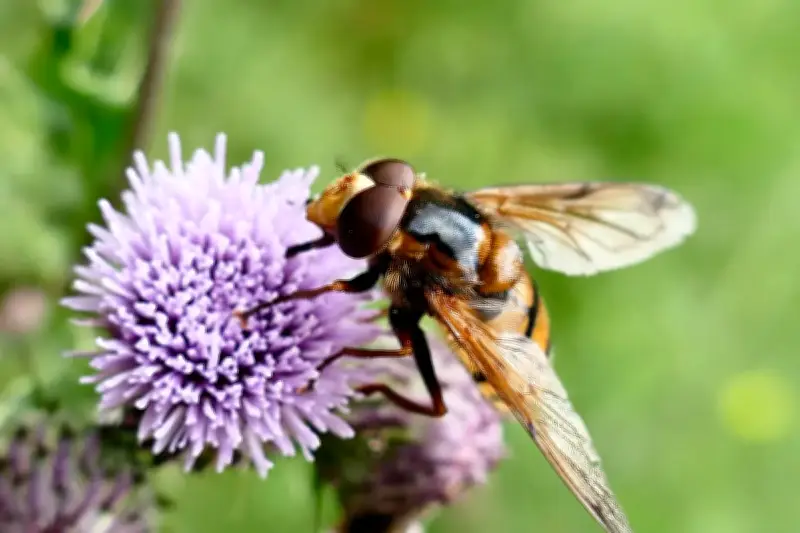
The hornet mimic hoverfly, Volucella zonaria, is a 2cm-long fly that mimics the appearance of hornets to deter predators, a survival strategy that has proven effective since its arrival in Britain in the 1940s. This harmless insect, which has no sting, uses Batesian mimicry—where a harmless species imitates the warning signals of a harmful one—to fool would-be attackers. Its range has expanded rapidly across the UK, driven by increasingly hot summers, and it now shares its habitat with three hornet species.
A master of disguise in the heatwave
In a bend of the heatwave, a remarkable fly lands on a rose leaf in full sun. The hornet mimic hoverfly, Volucella zonaria, is a "stonking great" (for a hoverfly) 2cm-long creature with a peachy-yellow and black striped abdomen. It has no sting, a chestnut thorax, and a big-eyed head with a pad for nectar, not jaws for chomping insects. It has two rather than four cellophane wings folded at rest, and an aura to unnerve the uninitiated.
On close inspection, the hornet mimic hoverfly is not a convincing hornet, but first impressions count for would-be predators. This kind of mimicry is called Batesian, where harmless species transmit the warning signals of harmful species. If their larvae can live as commensals, feeding safely in wasp and even hornet nests—called Mullerian mimicry—they must have something more than an inexact visual similarity to their hosts.
Range expansion and hornet counterparts
These hoverflies arrived in Britain in the 1940s, expanding their range rapidly by migrations from Europe, pushed on by increasingly hot summers. As their range covers Europe, west and central Asia, and Russia, the question arises: are they mimics of the European hornet, Vespa crabro, the Oriental hornet, Vespa orientalis, from southern and eastern Europe, or even the yellow-legged Asian hornet, Vespa velutina, all of which are now in Britain?
Researchers such as Róbert Bohát are interested in the link between human cognition and animal mimicry as metaphors for survival. A hoverfly that is non-aggressive and herbivorous becomes a hornet that is an aggressive predator through the transmission of signals—mimicry as a bio-metaphor. Metaphor, stating what something is by describing what it is not, is so much part of our language that the poetic metaphor has its own meaning.
The art of survival in the analogue world
The hoverfly stays still on the leaf in bright sunshine, protected by identity theft, before buzzing off into a poetry of its own existence. In the analogue world, intelligence is art, not artifice. This remarkable insect demonstrates how evolutionary techniques can be both poetic and practical, blending seamlessly into its environment while deterring predators with a mere visual trick.



