
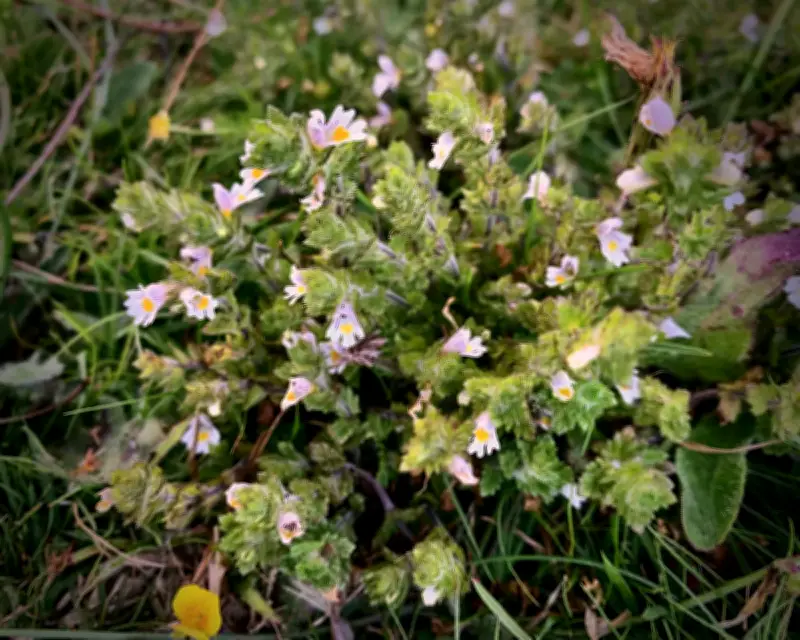
Eyebrights flower in the short turf of Old Racecourse Common, Oswestry, as sunlight burns through rowan trees, casting sunset colors on the grass. These annuals have tiny flowers, 4mm-11mm long, with a violet vibe, a white corolla with purple marks, and a central flash of yellow.
Eyebright Species and Taxonomy
About 20 British eyebright species exist, some endemic. Their genetic complexity makes them a taxonomic puzzle. "Life's too short to key out eyebrights," one botanist noted. This specimen is Euphrasia officinalis agg, an aggregate of species, microspecies, and hybrids, including E nemorosa, the common eyebright.
Parasitic Nature and Ecological Impact
Belonging to Orobanchaceae, eyebrights are hemi-parasitic, capable of independent living but also sending roots to penetrate grass roots, siphoning water and nutrients. This reduces grass dominance and changes turf composition.
Medicinal and Symbolic Uses
Euphrasia comes from the Greek word for cheerfulness. According to the medieval Doctrine of Signatures, gazing at these flowers can help sight and mood. Eyebright is an ancient medicinal herb with aucubin, iridoid glycosides, lignans, and flavonoids, used in tinctures and compresses for eye problems. It also promotes wellbeing and was burned as incense for divination.
Conservation Challenges
The future of eyebrights faces threats from lack of grazing and encroaching bracken, recently cut here. Conservation must balance preserving distinctive species with maintaining processes that create eyebright diversity. Under the Changing Skies: The Best of the Guardian's Country Diary, 2018-2024, is available now.



