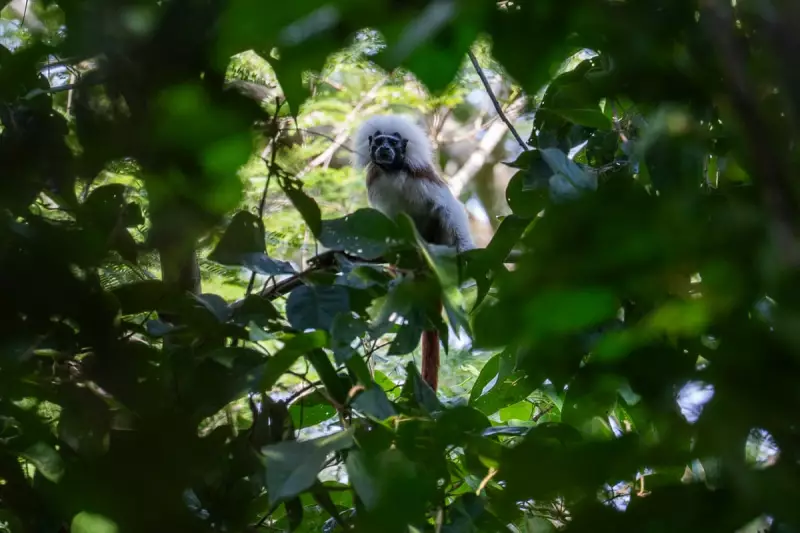
In the dwindling tropical dry forests of northern Colombia, a profound transformation is underway. A dedicated team, including former loggers and farmers, is working tirelessly to reverse decades of environmental damage and secure a future for one of the planet's rarest primates: the cotton-top tamarin.
The Logger Who Learned to Listen
Luis Enrique Centena once made his living by cutting down the very trees that sheltered the forest's inhabitants. For years, his focus was on providing for his family, with little thought for the small, white-maned monkeys watching from the canopy. "I used to cut trees and never took the titís into account," says Centena, using the local name for the cotton-tops. "I ignored them. I didn't know they were in danger of extinction."
Today, his relationship with the forest is radically different. Now a key member of the conservation initiative Fundación Proyecto Tití, Centena uses radio telemetry to track the monkeys, his whistle a call of recognition rather than a prelude to destruction. "Now we have become friends," he reflects, a sentiment emblematic of the project's community-led approach.
A Species on the Brink
Weighing less than half a kilogram, the cotton-top tamarin is critically endangered. Its population, estimated at fewer than 7,500 individuals, survives only in northern Colombia's tropical dry forest—an ecosystem reduced to a mere 8% of its original size due to cattle ranching and logging.
The threats are multifaceted and historical:
- Medical Research: Tens of thousands were exported to the United States in the 1960s and 70s.
- Habitat Loss: Clearance for agriculture and pasture has left just 720,000 hectares of fragmented forest.
- Illegal Pet Trade: Poachers still capture the tiny, expressive monkeys, selling them for as little as 60,000 to 100,000 Colombian pesos (approx. £12-£20).
Franklin Castro, an environmental guard, has rescued more than 200 trafficked tamarins. "We find the titís trembling and dehydrated. It's a terrible sight," he reports, highlighting the ongoing battle against the illicit trade.
Stitching the Forest Back Together
Led by Rosamira Guillen, Proyecto Tití's strategy is one of active restoration. After acquiring a grant nearly a decade ago, the NGO purchased its first plot of barren, degraded land. "There was nothing left," recalls Marcelo Ortega, who leads the tree restoration work.
The project has since scaled up dramatically. The team now manages more than 13 plots across nearly 1,000 hectares, collaborating with over 100 local farmers. To date, they have planted about 120,000 native trees and shrubs, with plans for 60,000 more next year. The goal is to create wildlife corridors, stitching isolated forest patches back into a cohesive whole.
"Our goal is to restore what once existed," says Ortega. The results are beginning to show. "The cotton-tops are starting to come into the new forest to forage. It's amazing to see," says Guillen.
Guardians of a Wider Ecosystem
The conservation effort, supported by meticulous monitoring using tiny transmitter 'backpacks' on dominant males, is about more than just one species. The regrowing forest benefits a host of other rare creatures, including black spider monkeys, toucans, tamanduas, and rare turtles. Notably, a puma was recently caught on camera in the area for the first time in years.
"When you protect the forest for cotton-tops, you protect it for everything else that lives there," Guillen emphasises.
For Luis Enrique Centena, the work is personal redemption. "I was cutting trees down for 25 years. I've been here since 2018, so I have about 10 more years to make up for the mistakes I made," he states.
The upcoming census is eagerly anticipated, with early indications suggesting the cotton-top population has remained stable or even grown since the last official count in 2012-13. In the hills outside San Juan Nepomuceno, the sound of the forest is no longer being silenced—it's being carefully, passionately rebuilt.