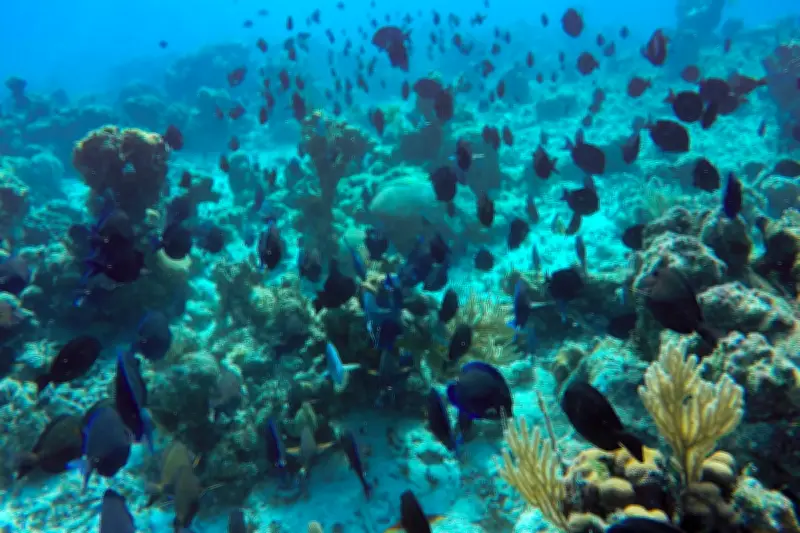
At 8am, scuba divers gather to collect plastic and drinks cans from the sea at Cuba’s Ciénaga de Zapata national park. Amid a power crisis that has virtually paralysed the country’s economy, they use an electric trailer to move to a designated spot. In only a few hours, they have collected five sacks of cans and waste.
Lack of environmental awareness, invasive species and the climate crisis have long threatened the island’s pristine marine ecosystem but as US sanctions and economic scarcity take their toll on the country, scientists and community conservationists are working with even scarcer resources to protect a vital ecosystem for the Caribbean and the world.
Coral cover in the Caribbean has decreased by 48% since 1980, according to a recent report by the Global Coral Reef Monitoring Network, making joint action between countries essential. Yet deteriorating relations between the US and Cuba are hindering conservation efforts in the Gulf of Mexico.
Cienaga de Zapata: A model for marine conservation
Ciénaga de Zapata in the south-east of the country is a good example. The national park, a world-renowned site for marine conservation, is recognised as a biosphere reserve and a Ramsar site for its biodiversity and geodiversity.
“Compared with other places, we don’t have major polluting sources,” says Marileidy Albertus, a specialist in exotic and wild species at the National Aquarium in Havana. “We don’t have big industries, oil spills are almost nonexistent, maritime transport is also limited, and for many years, agroecological practices have been implemented.”
Although the global use of inorganic fertilisers has grown rapidly, Cuba’s limited use of chemicals in farming has reduced the impact on its reefs. Likewise, the island has been slower than other Caribbean regions to experience coral diseases such as stony coral tissue loss disease (SCTLD), which is spread by international shipping – an activity that also causes pollution and harms corals through anchoring and grounding.
“Coral restoration was not even a topic of discussion in Cuba. We could observe small reductions due to climate change, but not drastically,” says Albertus.
All that changed in 2023, when SCTLD and an intense bleaching event damaged the reefs, prompting the Cuban government to adopt a new policy to protect them.
US blockade hampers conservation efforts
Although relations between Cuba and the US improved during the Obama years, leading to a bilateral agreement on marine conservation, the current crisis and the climate-sceptic Trump administration have hampered on-the-ground projects.
The situation has worsened since the oil blockade imposed by the US. Petrol is essential for scientists to carry out and monitor existing projects, for transporting volunteers over long distances, and for the government to control illegal fishing.
“The US administration’s decision to underinvest in the environment is extremely misguided and self-defeating,” says Daniel Whittle, an expert in US and Cuban environmental law and policy and director of the Resilient Caribbean initiative. “Cuba contributes very little to climate pollution and has been very proactive since 1992 in having a climate strategy … They understand, as an island nation, how without these common resources everyone loses.”
At the National Aquarium in Havana, scientists have to deal with scarcity every day. They must manually provide oxygen to the fish tanks housing fragile species during power cuts, struggle to acquire equipment made in the US or sourced from companies there or have access to scientific journals and magazines associated with the US. Also, NGOs have difficulty providing funding and getting Cuban scientists to international events.
Local conservationists step up
Luis Mesa, a conservationist scuba diver in Ciénaga de Zapata, compares the restrictions on their work with freediving. “With scuba diving gear there are so many possibilities: you can go deeper and stay underneath the water for longer. But to protect the ecosystem, our resources are limited,” he says.
Scientists increasingly have been relying on a network of local conservationists, who monitor the area and report changes to experts. “After I changed from military to recreational scuba diving, I realised that protecting marine life is important,” says Jorge Sánchez, who has learned about conservation and marine life through local institutions.
With the help of volunteers such as Mesa and Sánchez, marine biologists at the National Aquarium are using freediving techniques to conduct experiments at a depth of 17 metres in a spot accessible by swimming from their workplace – a way to reduce fuel use and address scarcity.
They are also developing their own substrates for coral restoration, and use recycled materials, such as broken clay and leftover cables from the national telecoms company.
Since 2019, they have been experimenting with coral farming through fragmentation and the assisted reproduction cycle (IVF). Now they are innovating by combining the two techniques, an expensive, time-consuming practice not used elsewhere due to its logistical complexity.
“Most organisations depend on financing, and working on long-term projects like this is not easy,” says Albertus.
Economic pressures threaten conservation gains
While overtourism causes environmental problems elsewhere, in Cuba the decline in the tourism industry due to the pandemic and the tightening of the blockade, including a lack of fuel for commercial airlines, has also threatened conservation gains.
Many people who were making a living from renting out houses are returning to their original activities, such as illegal fishing and other practices that damage the ecosystem. “If there aren’t any tourists, they will go back to fishing because that’s what they know,” says Mesa.
Eduardo Abrego, a biologist with years of experience in Ciénaga de Zapata, adds: “The worst enemy of conservation is necessity. Humans always try to find a solution to their hardship in nature.”