
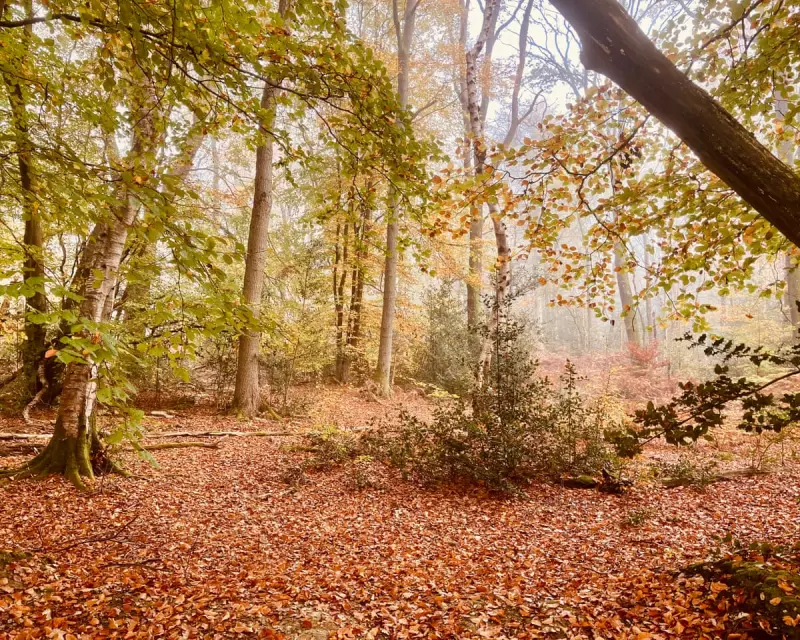
In a curious twist of fate, a simple woodland walk in early December became a surreal and enchanting experience for one naturalist, who found himself navigating the forest floor with a broken leg. The resulting stillness and forced patience opened a window to a remarkable avian spectacle that might otherwise have been missed.
A Forced Pause in the Forest
The observer, whose mobility was hampered by a recent fracture, had ventured into a quiet wood in Northumberland. The date was Tuesday, 3 December 2025. Progress was slow and deliberate, a stark contrast to the usual brisk pace of a countryside ramble. This imposed slowness, however, transformed from a limitation into a gift. The usual rustle of movement through undergrowth was absent, allowing for a deeper, more acute level of listening and observation.
It was in this state of heightened awareness that the first unusual sounds filtered through the pine-scented air. The distinctive, sharp calls were not those of the common chaffinch or other frequent woodland residents. Instead, they belonged to a more specialised and nomadic visitor.
The Chorus of the Crossbills
Above, in the canopy of a tall Scots pine, a lively flock had gathered. They were common crossbills (Loxia curvirostra), a finch species uniquely adapted to life among conifer cones. The scene was described as dreamlike, a moment so vivid and unexpected it blurred the line between reality and a strange, pleasant dream. The birds were not merely silent foragers; they were in full, melodic voice.
Their song, often overlooked in favour of their metallic 'jip-jip' call notes, was a complex and cheerful warble. The observer noted the richness of their communication, a social chorus that filled the woodland space. The flock comprised both males and females, offering a splash of colour amidst the evergreen needles. The males displayed a striking brick-red plumage, while the females were a more subtle but elegant olive-green and grey.
The most fascinating aspect of their behaviour was the purpose behind their unique anatomy. Their namesake crossed bills are not a deformity but a perfect evolutionary tool. The birds use them with expert precision to prise open tightly closed conifer cones and extract the nutritious seeds within. Watching this specialised feeding technique from a stationary vantage point was a rare privilege.
Reflections on Stillness and Observation
This entire encounter served as a powerful reminder of the rewards that come from quiet patience in nature. The broken leg, while a physical setback, became the very reason for the experience. It forced a complete halt, a surrender to the immediate environment. In our fast-paced lives, such moments of compelled stillness are rare, yet they can unveil the hidden dramas of the natural world that rush past us unnoticed.
The common crossbill is a species tied to the bounty of cone crops. They are known to irrupt—suddenly appearing in areas far outside their typical range—when food sources fail in their usual haunts. Their presence in a Northumberland wood that day was a small testament to the dynamic and unpredictable movements of British wildlife. Observing them felt like witnessing a secret chapter of the forest's life, one normally reserved for the most patient or the most fortuitously immobile.
The diary entry concludes with a lingering sense of wonder. The memory of the singing crossbills, set against the backdrop of personal physical adversity, created a poignant and lasting impression. It underscores a fundamental truth for any nature enthusiast: sometimes, you have to stop completely to truly see and hear the magic unfolding around you.



