
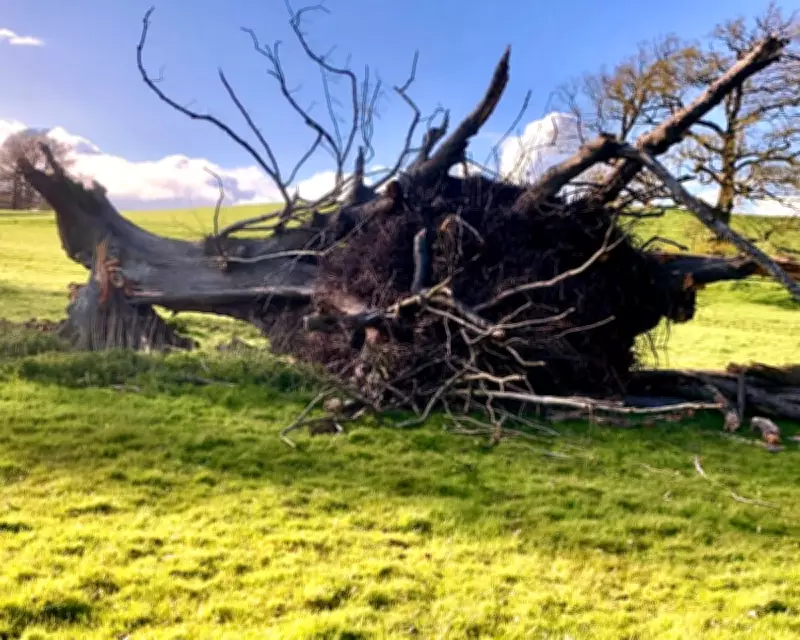
The Sudden Fall of a Landscape-Defining Ancient Tree
How swiftly something that has defined a landscape for centuries can transform into the very absence that redefines it. This poignant reality is vividly illustrated by the fate of ancient trees, as recently witnessed in The Marches of Shropshire. A magnificent common lime tree, which had stood as a sentinel for approximately three hundred years, met its dramatic end when Storm Dave struck with ferocious intensity.
A Tree's Final Day and Violent Demise
Just one day prior to the storm, the author observed this great lime tree with a sense of awe and contemplation. Despite its architecture being composed largely of dead wood, the tree appeared vividly alive, its form a testament to persistence through years of trouble and change. Standing alone in the landscape, with the vitality of spring coursing through both the land and its ancient timbers, the observer pondered how much longer, in tree-time, this venerable giant might endure.
Storm Dave provided a swift and definitive answer: "None." The trunk snapped at the roots with a sound reminiscent of a carrot breaking, crashing to the ground in a catastrophic collapse. Its bony branches splintered upon impact, leaving the tree lying like a shipwreck stranded in an open field. The massive hulk of twigs now resembles an animal pelt that has been suddenly stilled, a stark contrast to its former towering presence.
Historical Significance and Botanical Identity
This fallen tree has been identified as a common lime, scientifically known as Tilia x europaea. This species represents a hybrid of our native small-leaved lime (T. cordata) and the large-leafed lime (T. platyphyllos). While its origins may be natural or possibly introduced, the common lime has certainly been widespread since the extensive plantings of the 17th and 18th centuries.
During that historical period, it was commonly referred to as the Dutch lime due to the prevalence of specimens sourced from Dutch nurseries. These trees were extensively planted throughout Europe in parks, avenues, gardens, and streets, often as part of the baroque landscaping style that emphasized grandeur and symmetry.
This particular individual may belong to the variety known as 'Pallida,' which served as a major component of parkland estates such as the one at Llanforda and others surrounding Oswestry. Based on its substantial girth, considerable height, distinctive browny-red leaf buds, and the extensive thatch of epicormic twigs that covered approximately one-third of its bulk, this tree likely dates back to the 18th or early 19th century.
A Georgian Survivor and Archaeological Discovery
This lime tree stood as a Georgian survivor of a countryside idyll characterized by sweeping vistas and magnificent trees that defined the ecological and aesthetic vision of the era. Following its collapse, the author fashioned a digging stick to explore the duff of decayed wood and soil exposed when the trunk broke apart.
The investigation revealed fascinating artifacts buried beneath centuries of growth:
- A shard of stone
- A hollow finger of wood
- A fragment of green glass from what appears to be the corner of a flat-sided bottle
When held up to sunlight, this glass fragment revealed tiny bubbles of air trapped during its manufacture—air that had not seen daylight since the tree was originally planted. This discovery raises intriguing questions about the human story connected to this tree's planting. Was this bottle once containing gin or laudanum, consumed by someone who took a final swig before discarding it into the hole where the lime tree would take root? Could this have been an unconscious libation to the tree that would grow above it for centuries?
The fallen common lime now lies as both a monument to what was and a catalyst for redefining what the landscape has become. Its absence creates a new focal point in the field, transforming how we perceive and experience this corner of Shropshire. The tree that once defined the vista through its presence now defines it through its dramatic absence, reminding us of the impermanence that underlies even the most seemingly permanent features of our natural world.



