
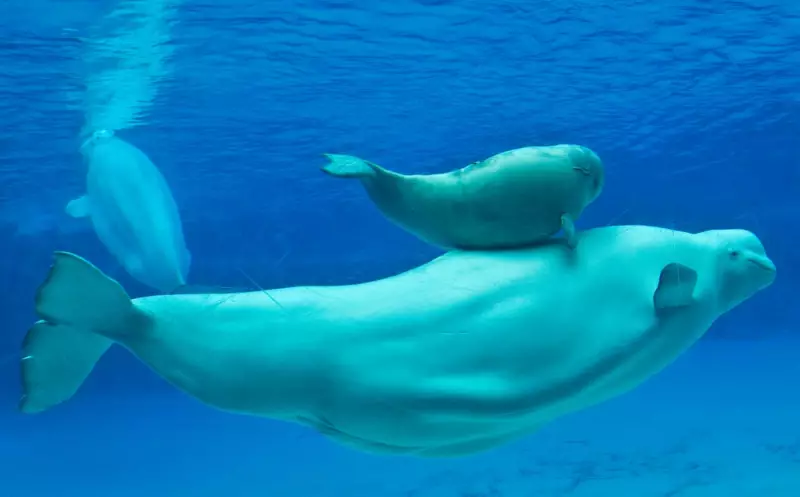
A Heartbreaking Standoff: The Plight of 30 Beluga Whales
Thirty captive beluga whales have become unwilling pawns in a bitter dispute between a struggling Canadian amusement park, various levels of government, and animal rights activists. Their health and freedom now hang in the balance, with their future looking increasingly uncertain.
The belugas reside at Marineland of Canada, an embattled park near Niagara Falls, Ontario. The situation escalated after the federal government blocked the sale of the whales to China. In a shocking turn, Marineland threatened to euthanise the animals unless the government covered the costs of their care—a demand that Canada's fisheries minister has firmly rejected.
The Personalities Behind the Predicament
Amidst the political wrangling, the individual whales—each with distinct personalities—are often overlooked. Former beluga trainer Kristy Burgess, who spent three years working closely with them, describes them with affection.
She recalls Bertie Botts as an adorable "ham sandwich", Orion as a fiercely protective friend, Zephyr as a wiggly character with "ants in his pants", and Lillooet as a "biggest cuddle bug". Burgess developed deep bonds, particularly with two females: Eve, who chose her, and Cleopatra, who made her earn that trust.
Building relationships with these intelligent marine predators required immense consistency and love, she explained. Gaining their trust was a slow process that ultimately became a magical and rewarding experience, revealing the complex social and emotional lives of these mammals.
A Deteriorating Environment and Mounting Deaths
This connection was forged against a grim backdrop. During Burgess's three-year tenure, seven belugas and the park's lone killer whale, Kiska, died. In total, 19 belugas have died at Marineland since 2019.
While the park attributes this to natural causes, campaigners point to deteriorating conditions. Burgess witnessed this first-hand, noting that the park did not open to the public last summer. She reported seeing concrete breaking off from the tanks, with curious whales picking up and swimming with the chunks in their mouths—a sight she found heartbreaking.
Marineland, which did not respond to a request for comment for this article, has previously stated that its whales receive superior, round-the-clock healthcare compared to humans. Burgess was fired in early March following the death of a beluga named Eos, which had to be euthanised, suspecting she had leaked details to the media.
Searching for a Viable Solution
The federal government's refusal to allow export to China was rooted in principle. The fisheries minister stated that approving the request would have meant "a continued life in captivity and a return to public entertainment", affirming that whales belong in the ocean, not tanks.
However, Burgess argues this reflects a misunderstanding. These whales, born in captivity, will require human care for the rest of their lives and cannot simply be released into the wild. A proposal to release them into Canada's north was deemed unrealistic.
The most promising yet controversial solution is a proposed sanctuary in Nova Scotia. This 100-acre penned ocean facility has received government approval but does not yet exist. Charles Vinick, leading the project, says construction could be completed in eight or nine months, potentially rehoming up to ten healthy whales by early summer. He promises to replicate the intellectual stimulation and diet the whales receive from trainers in a vastly larger space.
Yet, Burgess and other trainers are wary, viewing the plan as an unproven experiment. Meanwhile, lawyer and activist Camille Labchuk suggests that some whales might need to remain at a significantly improved Marineland, while others could be rehomed to US aquariums. She criticises the governmental paralysis, noting that multiple bodies have the power to act but instead pass responsibility, creating a "crap situation" for the whales caught in the middle.



