
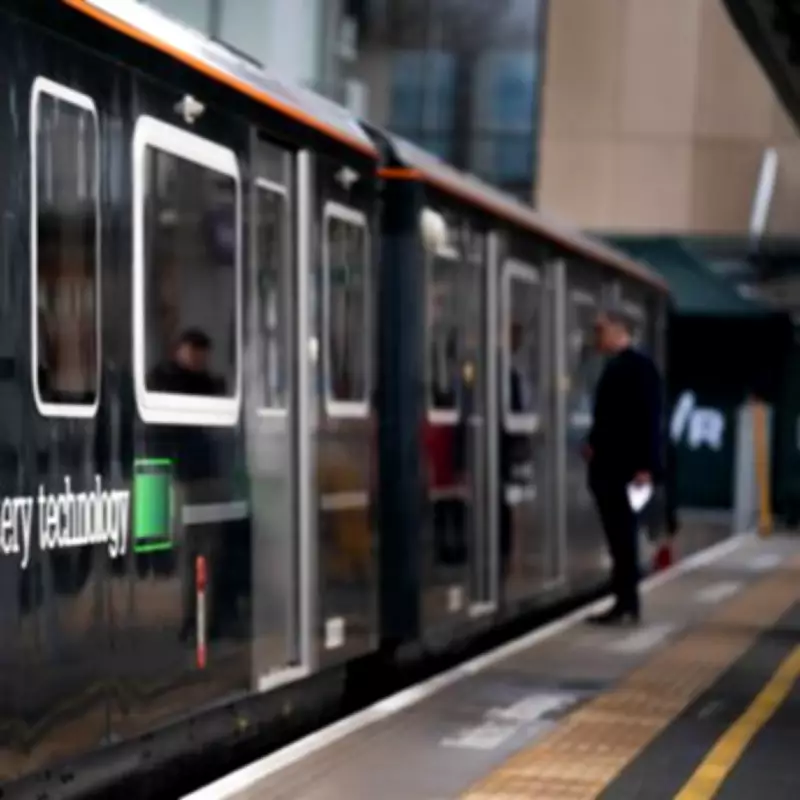
The United Kingdom's railway network has reached a significant milestone with the introduction of its first passenger train operating exclusively on rapid-charging battery technology. This pioneering service will commence operations this Saturday, representing a crucial advancement in sustainable transport for London and the wider nation.
A New Era for London's Rail Network
This innovative battery-powered train will replace the existing diesel service on the Greenford branch line, a two-and-a-half-mile route in west London. The transition marks a tangible step toward cleaner urban transport, with the rail industry actively working to phase out diesel-only trains by 2040.
Proven Technology Through Extensive Trials
Great Western Railway (GWR) has been rigorously testing this technology on the Greenford route since May 2024. The train itself is a repurposed former London Underground District line carriage, now fitted with advanced battery systems that demonstrate remarkable efficiency.
What makes this system particularly innovative is its charging mechanism. The batteries are replenished during brief four-minute turnarounds at West Ealing station, allowing for continuous operation without lengthy downtime. This rapid-charging capability addresses one of the traditional limitations of battery-powered transport.
Record-Breaking Performance and Cost Benefits
The trial has yielded impressive results on multiple fronts. In July last year, GWR announced that initial findings showed the infrastructure required for charging battery trains was substantially cheaper than full electrification with overhead lines. This cost advantage could accelerate the adoption of similar technology across less-busy rail routes nationwide.
Even more remarkably, just a month after that announcement, the battery train set a new world record by traveling 200.5 miles on a single charge – the longest distance ever achieved by a battery-powered train. This performance demonstrates the technology's readiness for practical application beyond short shuttle services.
Phased Introduction and Future Expansion
Initially, passenger services will operate on Saturdays only, beginning with the 5.30am departure from West Ealing to Greenford. However, railway officials express optimism about gradually increasing the service frequency throughout the year as operational experience grows.
Dr Simon Green, GWR's engineering director, emphasised the project's significance: "This is a crucial moment for all involved in this innovative project, coming at a vital time as we focus on replacing our aging diesel fleet. Our fast-charge trial has successfully shown that battery technology offers a reliable and efficient alternative where overhead lines aren't feasible."
Industry-Wide Implications for Decarbonisation
Marcus Jones, Network Rail's Western route director, whose teams installed the charging infrastructure, described the project as "a major step forward for sustainable rail travel in Britain." The knowledge gained from this operational service will inform not only GWR's decarbonisation plans but those of the entire rail industry.
GWR is collaborating with the Department for Transport and other train operators to develop the strongest financial case for investment in battery-powered trains. While Merseyrail operates trains that use batteries for short distances, those are primarily recharged from electric third rails, making London's rapid-charging system particularly innovative for mainline applications.
This landmark development represents more than just a new train on a branch line – it's a practical demonstration of how battery technology can transform Britain's railway network, reducing emissions while maintaining reliable service on routes where full electrification would be prohibitively expensive or technically challenging.



