
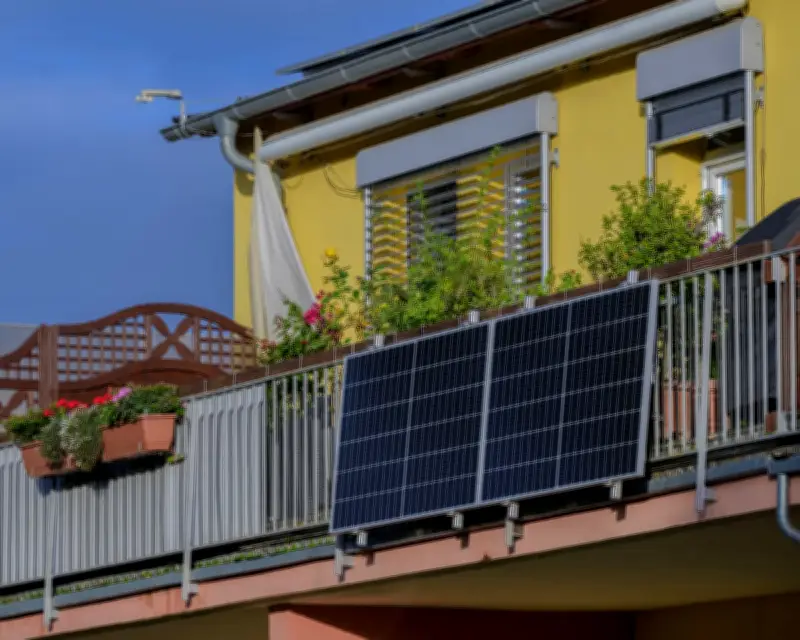
From 27 August, British households will be able to buy plug-in balcony solar panels after the government changed the law, allowing major retailers to bring them to market for the first time. The legislation, passed last week, enables people across the country to generate their own electricity using these devices, known in Germany as Balkonkraftwerke (balcony power plants).
How balcony solar panels work
Unlike traditional rooftop solar panels requiring professional installation, balcony solar setups can be plugged into a standard three-prong wall socket. They generate cheap electricity from a balcony, terrace, shed roof, or any outdoor space. The clean energy flows directly into the property’s electrical circuit, powering appliances and reducing reliance on the grid.
Retailers and cost savings
Retailers including Currys, B&Q, Asda, Screwfix, Wickes, and Amazon—who met the government earlier this summer to discuss guidelines—will be able to sell DIY solar setups. Expected to retail for at least £400, these systems could shave up to £110 a year off energy bills. Chris Hewett, chief executive of Solar Energy UK, said the move brings “cheap, clean power to households that have not been able to access these benefits before.”
Capacity and payback period
Plug-in systems typically have a capacity of 800 watts, about one-fifth the size of a standard rooftop solar system. While not enough to power a home alone, they can reduce bills by £70-110 annually, meaning a payback period of four to seven years. Hewett added, “Our industry is working closely with government to ensure that all customers can have confidence in the safety and reliability of these new technologies.”
Record solar installations amid energy crisis
The DIY solar systems arrive as record numbers of British households turn to green energy upgrades to cut costs, with global energy prices soaring due to the war in Iran. A record 269,000 solar installations were completed in the UK last year, over a third more than the previous year—equivalent to a new rooftop installation every two minutes.
Future potential: plug-in batteries
Rob Hallifax, co-founder of Windfall Energy, said the legislation could also pave the way for plug-in batteries in British homes. The government is reportedly considering bulk-buying devices for low-income homes, according to the i Paper. These batteries could store electricity when abundant and supply power when tight. Paired with solar panels, households could store renewable energy during the day for evening use. Hallifax called the move a “massive win for consumer energy independence” and a “huge leap forward for anyone who has previously been locked out of the energy transition.” He noted that renters, flat owners, and budget-conscious individuals now have access to clean energy “in a way we haven’t seen before.”
Practical considerations
Hallifax advised setting “realistic expectations”: generation declines after August as autumn and winter approach. Users need a sunlit balcony, terrace, or suitable outdoor area, and may require permission from a landlord or freeholder to install panels.



