
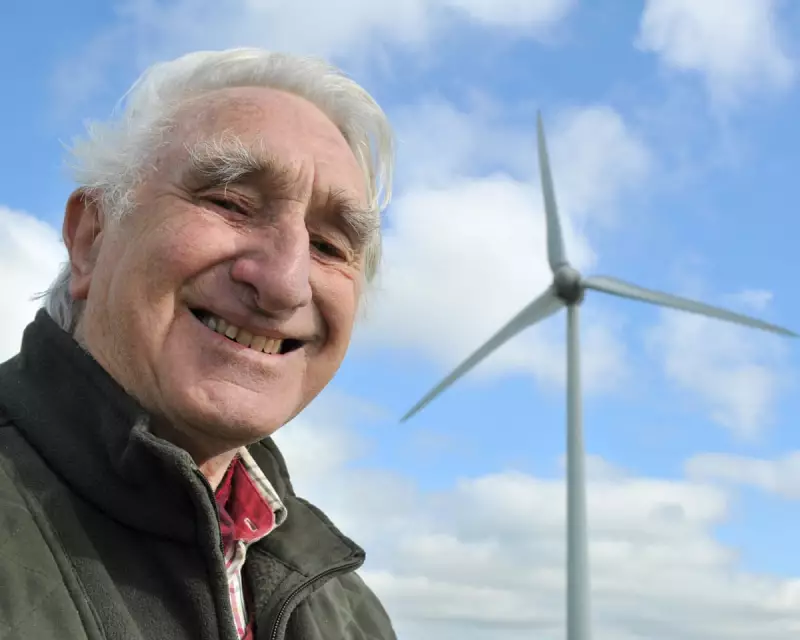
The UK renewable energy sector is mourning the loss of one of its true pioneers, Peter Edwards, who has died at the age of 90. Edwards will be remembered as the visionary behind Britain's first commercial windfarm, establishing a legacy that continues to power thousands of homes and inspire the green energy movement.
The Delabole Windfarm Legacy
In 1991, Edwards transformed his family farm in Delabole, north Cornwall, into what would become a landmark in British energy history. The Delabole windfarm began operations with ten 400kW turbines, feeding clean electricity into the National Grid and providing power for nearly 3,000 households.
The project demonstrated remarkable longevity and adaptability. After two decades of service, the original turbines were decommissioned in 2010, making way for an £11.8 million rebuild. The upgraded facility installed four more powerful turbines with a combined output of 9.2 megawatts, significantly increasing its capacity to supply electricity to more than 7,800 homes.
A Life Dedicated to Sustainable Energy
Edwards's commitment to renewable energy extended far beyond his own windfarm. Through his consultancy firm, Windelectric Management, which he operated with his son Martin, he helped dozens of other farmers negotiate agreements with wind turbine operators seeking to use their land.
His expertise and passion for sustainable energy earned him significant roles within the industry. During the 1990s, he served as a member of the parliamentary renewable and sustainable energy group. He chaired the British Wind Energy Association from 1996 to 1998 and later led the Renewable Energy Association between 2002 and 2004. His knowledge was so respected that he was frequently invited to speak at prestigious events, including the World Renewable Energy Congress.
From Farming to Renewable Visionary
Born in King's Lynn, Norfolk, Edwards was the only child of Violet and George Edwards. His father's career as an RAF squadron leader meant frequent postings abroad, leading Peter to spend much of his childhood with his mother and maternal grandmother on the Isle of Wight, where he attended Ryde school.
After accompanying his parents during a posting to the United States, Edwards returned to Britain in 1955 to study agriculture at the University of Reading. It was there he met fellow student Philippa Fielding, whom he married in 1958. The couple went on to have three children: Martin, Jeremy, and the author of his obituary.
After graduating in 1959, Edwards embarked on a two-year contract as a government conservation officer for the Federation of Rhodesia and Nyasaland (now Zambia, Malawi, and Zimbabwe), where he designed and implemented plans for soil conservation, drainage, and water storage.
The family returned to Britain in 1961 to establish their farm in Delabole, with Philippa working as his partner in the business. When the dairy industry became increasingly challenging, they made the pivotal decision to sell their herd in 1987 and harness the abundant wind resources along the north Cornish coast.
This investment in wind energy was partly a constructive response to an unpopular proposal for a nuclear power plant at Luxulyan in mid-Cornwall, reflecting Edwards's determination to push Britain toward greener energy solutions.
Enduring Environmental Commitment
Throughout the windfarm's operation, Edwards maintained his commitment to sustainable land management. The site continued to produce grass for cattle and sheep, and approximately 500,000 native trees were planted on less productive areas, reflecting his dedication to low-intensity "nature-friendly" farming practices.
The Delabole windfarm changed ownership in 2002 when it was acquired by Good Energy, before being purchased earlier this year by UAE-based company Esyasoft.
Edwards's wife, Philippa, passed away in 2021. He is survived by his three children, five grandchildren, and four great-grandchildren, leaving behind a renewable energy legacy that continues to power British homes and inspire future generations of environmental innovators.



