
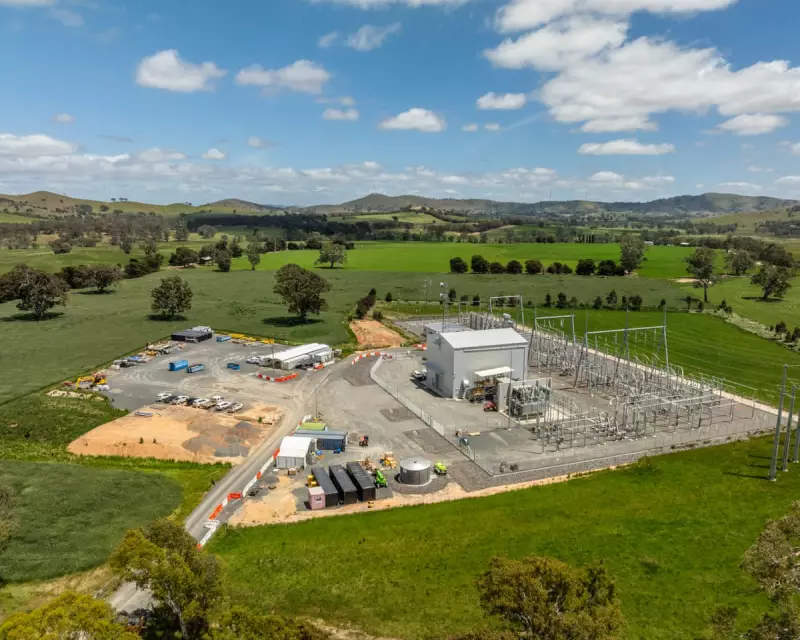
In the rolling green hills of western Victoria, a monumental engineering project has begun spinning into action. The Ararat synchronous condenser, a 150-tonne steel rotor, has commenced testing as Australia's largest device of its kind, marking a significant step in securing the nation's electricity grid during its clean energy transition.
The Spinning Giant of Western Victoria
Operators initiated the first rotation of this massive machine on 10 November, with comprehensive testing scheduled to continue until year-end before full operational deployment. Housed within a substantial grey structure adjacent to the Ararat terminal station, the sophisticated apparatus features a distinctive steel blue 'pony motor' that drives the enormous rotor at precisely 750 revolutions per minute.
This technological marvel, supplied by Austrian engineering firm Andritz, represents a substantial investment in grid infrastructure. The rotor operates almost frictionlessly, suspended by pressurised air above its 300-tonne frame, while an advanced cooling system maintains optimal operating conditions.
Reviving Vintage Technology for Modern Energy Needs
Although synchronous condenser technology dates back to the 1950s, it has found renewed purpose in contemporary energy systems. Australia has emerged as an early adopter, with the first domestic installation appearing at Ouyen in north-west Victoria during 2019. This was followed by four additional units in South Australia, representing an investment of approximately $166 million in that state alone.
The current expansion continues at pace, with New South Wales fast-tracking orders for five more machines. According to the Australian Energy Market Operator (AEMO), the capital cost for a synchronous condenser comparable to the Ararat installation reaches approximately $137 million. Research indicates that a fully renewable energy system might eventually require the equivalent of up to 40 such machines distributed throughout the national electricity network.
Strengthening Grid Security Through Mechanical Inertia
Glen Thomson, Chief Executive of project developer Australian Energy Operations, emphasises the transformative potential of this technology. "The Ararat syncon will unlock an additional 600MW of renewable energy in the region," he explains, "by replacing the stabilising qualities of synchronous generators without the associated emissions."
The fundamental purpose of these spinning machines lies in providing inertia – a physical property that resists and moderates frequency changes within the electricity grid, functioning similarly to mechanical shock absorbers. They also contribute to voltage control, both critical factors in maintaining Australia's alternating current (AC) system at its required 50Hz frequency.
Professor Michael Brear, Director of the Net Zero Australia project at the University of Melbourne, clarifies the importance of frequency stability: "It's what allows electricity to be transmitted over long distances. The important thing with frequency is to maintain it."
The Ararat installation forms part of the Victorian government's $480 million initiative to strengthen and modernise the state's electricity infrastructure, comprising one of twelve strategic projects. As coal and gas power stations gradually retire, synchronous condensers, alongside grid-scale batteries and advanced inverters at solar and wind farms, will collectively ensure system security in a renewables-dominated future.
Professor Brear notes the ongoing engineering discussion about optimal solutions but affirms that "we probably do need a certain amount of spinning metal to maintain system frequency." He describes synchronous condensers as a "robust and established" option that delivers essential services without imposing significant ongoing costs.
As Australia continues its ambitious energy transition, these massive spinning machines represent a crucial bridge between traditional power system principles and the renewable future, proving that sometimes the best solutions combine cutting-edge innovation with time-tested engineering fundamentals.



