
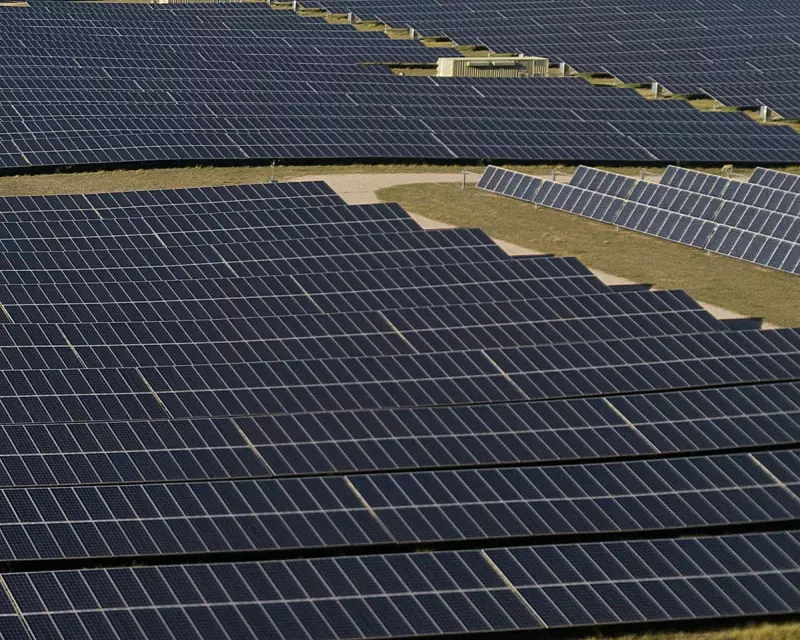
Australia's ambitious target of sourcing 82% of its electricity from renewable energy by 2030 is under serious threat, according to stark new warnings from investors. Data reveals that financial commitments for new large-scale solar and wind farms have plummeted to their lowest level in almost a decade.
A Decade-Low in Renewable Energy Investment
Official figures from the Clean Energy Regulator paint a concerning picture. The government agency now expects only 2.5 gigawatts (GW) of industrial-scale renewable capacity to reach a final investment decision this year. This marks a significant drop from the 4GW committed in 2023 and represents the weakest 12-month average for new project commitments since early 2017.
While renewable sources currently provide over 40% of Australia's electricity, experts stress that the current rate of construction is insufficient. To meet the federal government's 2030 goal, the pace of building new solar and wind farms must more than double over the coming five years.
'Deep Structural Issues' Behind the Slowdown
Industry leaders argue this investment slump is not a temporary blip but a symptom of profound systemic problems. Richie Merzian, chief executive of the Clean Energy Investor Group, highlighted a series of critical barriers.
"The structural issues include state planning delays, grid connection uncertainty, transmission constraints, rising project costs and lack of long-term revenue certainty," Merzian stated. He emphasised that the contrast between the large pipeline of potential projects and the few reaching financial close indicates a system that is not functioning as intended.
Frankie Muskovic, executive director of policy for the Investment Group on Climate Change, echoed these concerns, labelling the trend "a concerning" one that jeopardises both renewable energy and broader climate targets. These targets include cutting emissions by 43% by 2030 and at least 62% by 2035, compared to 2005 levels.
Government Schemes and the Urgent Need for More Support
The federal government's Capacity Investment Scheme (CIS), an underwriting programme for new solar, wind, and battery storage, has been a key policy response. Climate Change Minister Chris Bowen recently told parliament that over 16GW of projects are under contract or in negotiation through the scheme, with up to ten tender rounds still to come. He anticipates about 11GW of capacity will be financially committed by the end of 2026.
However, investors say more must be done. Muskovic argued that the CIS needs to offer greater support per project and should be extended beyond its scheduled 2027 closure to provide long-term confidence. "We need to be shoulder to the wheel on this, and state governments need to be along for the ride," she urged.
The warning comes alongside a separate alert from the Australian Energy Market Operator (AEMO). It stressed that urgent investment in new 'system security' infrastructure, like synchronous condensers, is critical if New South Wales' Eraring coal-fired plant is to close as planned in 2027 without destabilising the grid.
Despite the slowdown in new financial commitments, previously approved projects continue to connect. The Clean Energy Regulator estimates nearly 7GW of large-scale generation and rooftop solar could be added to the grid this year. Yet, the consensus is clear: without resolving the fundamental barriers deterring investors, Australia's clean energy transition risks falling dangerously short.



