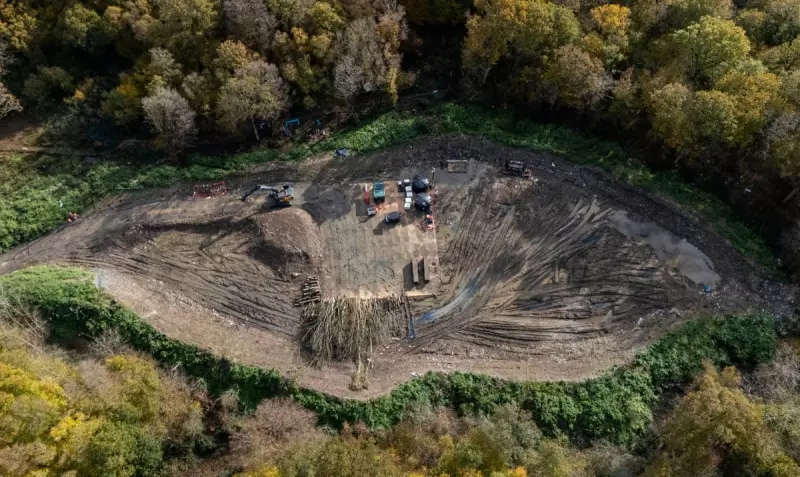
A massive environmental cleanup operation is underway in Kent, where specialists are battling to remove 35,000 tonnes of illegally dumped waste from protected ancient woodland. The £15 million project at Hoad's Wood near Ashford represents just one front in a growing national crisis.
The scale of Britain's waste crime epidemic
Behind metal gates in the Kent countryside, workers in hazmat suits are digging through mountains of rubbish that have turned a Site of Special Scientific Interest into a toxic wasteland. The cleanup began this summer, five years after residents first reported illegal dumping to authorities, providing names of companies involved and footage of the activities.
It took sustained campaigning by residents and environmental groups, plus the threat of legal action, to force the Environment Agency into action after government intervention. Meanwhile, organised criminals have increasingly turned to waste crime, described as the "new narcotics" for its profitability and low risks.
Six major illegal dumps operating nationwide
Across Britain, six other illegal waste dumps of similar or larger scale than Hoad's Wood are known to the Environment Agency, stretching from Lancashire to Cornwall. Hundreds of thousands of tonnes of waste - from household rubbish to toxic rubber, building materials and heavy metals - remain in place with little prospect of cleanup.
Two sites, near Sittingbourne in Kent and in Camborne, Cornwall, continue to receive illegal waste despite the Environment Agency's awareness of their activities. The agency states that investigations continue in Kent "with a view to stopping activity" and that large-scale deposits have been stopped in Cornwall.
Matthew Scott, Kent's Police and Crime Commissioner, revealed the problem is even more widespread than officially acknowledged. "I know of six in Kent alone," he said, describing the national list as just "the tip of the iceberg."
System failures and criminal impunity
A recent House of Lords environment committee inquiry found the Environment Agency was slow to respond to even the most flagrant illegal activities, while communities and environments suffered the consequences.
Liberal Democrat peer John Russell, who campaigned for the Hoad's Wood cleanup, warned: "Broken systems create broken results and what we need is a fundamental change." He expressed concern that Britain could follow Italy's path where organised crime dominates waste management.
The case of John Allison illustrates the challenges. The 77-year-old was jailed in 2021 for waste crimes that earned him over £800,000 in illegal profits from dumping in Lancashire. Despite being ordered to pay £368,682.50, he has failed to pay and was sent back to prison, with no money recovered.
Four of the large illegal dumps are now closed and inactive, but the Environment Agency lacks both funding and mandate to clear them itself. Instead, it attempts to force perpetrators to clean up their pollution - an approach that often fails even after successful prosecutions.
New environmental disasters unfolding
The latest crisis has emerged in Oxfordshire, where a three-acre field alongside the River Cherwell near Kidlington has become home to a mountain of household waste collected by local authorities. The dump poses an immediate risk to water quality, with pollution already seeping into the river.
Local MP Calum Miller has called for urgent ministerial direction to begin cleanup as an environmental disaster unfolds in his constituency. The Environment Agency issued a cease and desist notice to the landowner in July, but criminals dumped thousands of tonnes of waste in September before the agency finally blocked access last month.
Russell expressed disbelief at the situation, saying: "It felt like Hoad's Wood has been allowed to happen all over again." He criticised the agency for not deploying surveillance cameras after their initial response in July.
While Labour has increased the Environment Agency's budget for tackling waste crime by 50% to £15.6 million, critics argue the agency remains ill-equipped to tackle organised criminal networks operating on this scale.