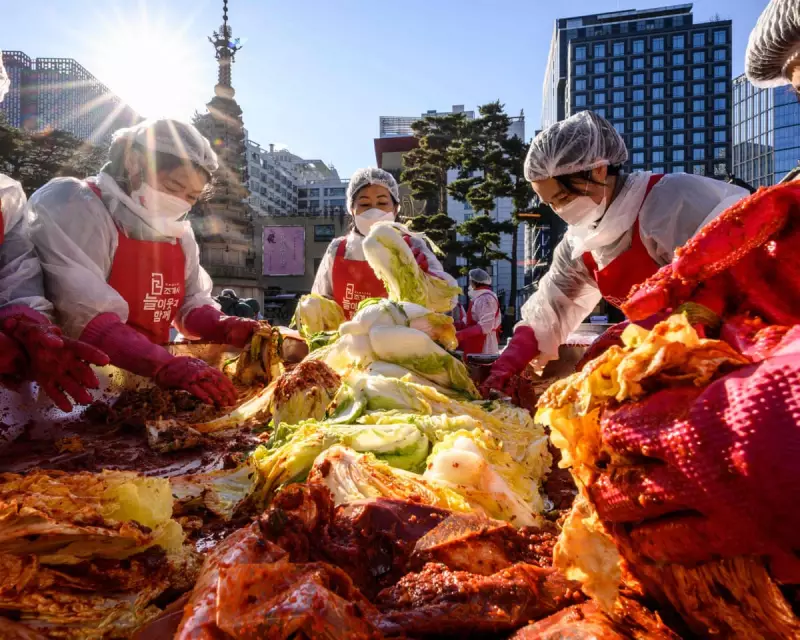
In a quiet apartment complex in Seoul's Gangdong district, Min Geum-nan approaches a high-tech bin with a small bag of vegetable peelings. A tap of her resident card opens the lid. After disposing of the scraps and scanning again, a digital screen delivers a precise verdict: 0.5kg. This simple, daily ritual is part of a national revolution that has positioned South Korea as a world leader in tackling the global scourge of food waste.
A National Transformation Driven by Necessity
The country's journey began in earnest in the early 1990s, when its primary landfills reached full capacity. This crisis sparked a major systemic overhaul, culminating in a nationwide pay-as-you-throw scheme in 1995. Residents were mandated to buy official rubbish bags, which initially reduced waste but created a new problem: soggy food scraps left in general waste caused significant odour issues.
The solution evolved over decades. In 2005, the government banned sending food waste to landfill entirely and made separation mandatory. The push for standardisation accelerated after 2013, when the ocean dumping of leachate—the liquid byproduct of food processing—was prohibited. The introduction of Radio Frequency Identification (RFID) bins in the early 2010s marked a technological leap, making disposal precise and transparent.
The results are staggering. According to South Korea's Ministry of Climate, Energy and Environment, the nation recycled 96.8% of its 4.81 million tonnes of food waste in 2023. In Seoul alone, the implementation of this system has led to a 23.9% reduction in food waste over a decade, dropping from 3,181 tonnes per day in 2013 to 2,419 tonnes.
How Technology Changes Kitchen Habits
For residents like Min Geum-nan, who has lived in her complex for 15 years, the RFID system, installed in 2020, has fundamentally altered household behaviour. "You have no choice but to pay attention because you can see exactly what you’re wasting," she explains. The fee—130 won (about 7p) per kilogram in Seoul—is automatically added to monthly maintenance bills, providing a direct financial incentive.
This has sparked ingenuity in homes. "Every household has its own method for squeezing out moisture," Min says. "If you don’t remove water, it gets expensive. People press it, drain it and even use strainers. You learn your own tricks." The ability to dispose of small amounts frequently has also eliminated concerns about smell and flies, making the process more convenient.
The behavioural impact is quantifiable. Studies across five Seoul apartment blocks found that once residents could see and pay for the exact weight of their waste, average reductions reached 51%. In the city of Siheung, south of Seoul, officials reported a 41% cut in buildings using the technology.
From Bin to Biofuel: The Processing Journey
The waste collected from bins like Min's—amounting to roughly 300 tonnes daily from East Seoul—embarks on a sophisticated recycling journey. It is transported to facilities like the Gangdong District Resource Circulation Centre, where processing machinery is built underground to control odours.
Here, the waste is shredded and foreign materials are removed. It is then pressed to extract water, with the liquid fed into anaerobic digesters to produce biogas. This biogas, in a circular economy model, powers the facility's own drying processes and odour control systems. The remaining solids, about 10% of the original volume, are dried and processed into animal feed.
Nationally, the output of this system is impressive: around 42% of recycled food waste becomes animal feed, 33% is compost, and 16% is converted into biogas.
Challenges and Future Ambitions
Despite its success, the programme faces hurdles. Central government funding for installation ended in 2014, leaving local authorities to finance new machines. Smaller or less affluent municipalities have struggled with budget constraints, reporting delays and slower uptake. Technical challenges also persist, with earlier machine models suffering corrosion from the high salt content of Korean cuisine, adding to maintenance costs.
Seoul is not resting on its laurels. The city has pledged to cut food waste by a further 20% by 2030 (compared to 2019 levels) and aims to expand RFID bin coverage to 90% of apartment complexes. From 2026, it plans to introduce a points-based reward system, offering households credits towards utility bills for reducing waste.
South Korea's model demonstrates that effective food waste management requires a multi-pronged, long-term strategy: landfill bans, mandatory recycling, precise measurement via technology, and dedicated processing infrastructure. For Min Geum-nan, however, the principle has become second nature. "Separating food from other rubbish is just obvious," she states. "It would be strange not to."