
Environmental Crisis Unfolds on Sussex Coast
A major environmental disaster has struck one of England's most beloved beaches as millions of plastic biobeads coat Camber Sands following a mechanical failure at Southern Water's Eastbourne Wastewater Treatment Works. The tiny black pellets, each roughly the size of a peppercorn, have spread across the shoreline, threatening both wildlife and the rare dune habitat that makes this area so special.
The Cleanup Battle Against Time and Tide
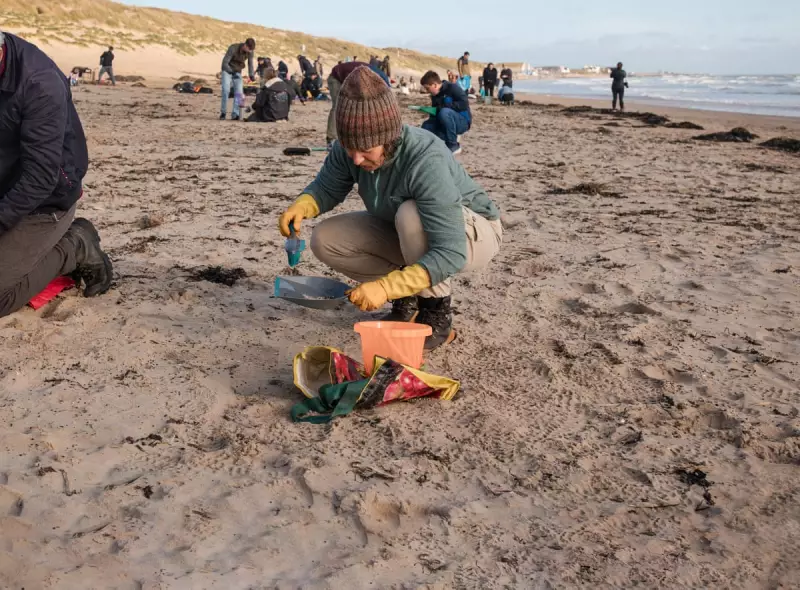
In the days since the spill, approximately 40 volunteers have descended upon the beach, working on hands and knees to painstakingly remove the minuscule plastic beads. The mind-numbingly tedious work involves either picking out individual beads by hand or using makeshift sieves fashioned from mesh onion sacks found nearby.
Roisin O'Gorman, a Hastings resident participating in the cleanup, explained their method: "We're scooping up the sand, then pouring the sand over a bucket into a sieve, and then pouring the water on top, so that we just get the beads."
Andy Dinsdale, founder of environmental organisation Strandliners, has been coordinating the cleanup effort and expressed visible exhaustion after days of continuous work. "They've got to get down on their hands and knees, almost into the strandline, to look for very small 5mm black pellets," he said. "We can only do our best." His dedication has been so intense that he missed his son's birthday celebrations to remain on site.
Futility and Frustration Amidst Growing Concerns
Despite the volunteers' valiant efforts, many feel a sense of helplessness against the scale of the contamination. The simple act of walking tramples the plastic further into the sand, and overfilled bin bags of collected waste can split, undoing hours of work.
Nick, a volunteer from Tunbridge Wells, voiced the frustration felt by many: "Kneeling on the sand, on your knees, just picking them out, one by one, is futile."
To address the overwhelming scale of the problem, environmental scientist Joshua Beech brought in a specialised microplastic removal machine resembling a giant vacuum cleaner. Beech, founder of cleanup organisation Nurdle, explained how the invention works: "It works by vacuuming up material, separating it by density, and then sieving and separating in the back so it comes out as nearly pure plastic in the collection trays."
Beech and his colleague Roy Beal have spent five backbreaking days operating the machine from sunrise to sunset, with Beech hoisting the heavy nozzle on his rugby player's shoulders while Beal manages it underarm.
Wildlife and Habitat Under Threat
The ecological impact of the biobead spill could be severe, according to Professor Tamara Galloway of Exeter University, who specialises in ecotoxicology. She warned that microplastics "overlap with the prey item size of many marine organisms and can enter the food web, with the potential to transfer contaminants into cells and tissues."
The beads can break down and leach harmful compounds that affect animals' hormones and cause reproductive problems. Local concerns have been heightened by the unusual stranding of three seals and a porpoise that recently washed up on the beach, though the UK Cetacean Strandings Investigation Programme currently doesn't believe these deaths are linked to the spill.
The contamination has now reached Rye Harbour nature reserve, Sussex Wildlife Trust's largest reserve. Site manager Paul Tinsley-Marshall described the area as "a matrix of wetland habitat" influenced by and linked to the sea, noting that "the vegetated shingle is a globally threatened habitat" home to more than 4,355 species.
According to Strandliners, there have been two previous large-scale biobead incidents reported to the Environment Agency in 2010 and 2017, but Beech describes the current situation as "the worst microplastic spill we've seen this year" - even worse than the nurdle spill in March when two ships collided in the North Sea.
Race Against Time and Funding Challenges
With sunset arriving at 4:20pm, volunteers face limited daylight hours. Cate Lamb, who travelled from London with her partner Khalid Flynn and eight-year-old daughter Maya, expressed the collective sentiment: "We feel like we're fighting a losing battle, a little, because of the scale of the challenge." Her words proved prophetic when her collection bucket split moments later.
Rother District Council has acknowledged that attempts to remove all the pellets have "proven impossible" and expects "further large amounts to be deposited in the coming weeks and months."
Beech and the Nurdle team hope to return after the next spring tide brings in more beads, but this depends on securing funding. "We can't afford to come back," Beech admitted. "But the environment needs us back."
While Southern Water has apologised for the spill, Helena Dollimore, MP for Hastings and Rye, is demanding the company fund both the cleanup and any future nature restoration. She's also calling for an independent investigation, stating unequivocally that "Southern Water cannot be trusted to mark their own homework."



