In his poem Haymaking, Edward Thomas describes a flower meadow where the fiery day 'had a kernel sweet of cold' and 'the white empty road was lightly strewn/With leaves'. At Hartington Meadows in Derbyshire, the heat was unrelieved, and the road's margin was liquefying. Sweat banded the cap and ran in creases at the backs of bare legs, where horseflies focused their attentions.
The Entangling Nature of Flower Meadows
Flower meadows, more than any other British land form, seem the most entangled and entangling places. They encircle and invade with a sense of richness: not just the entwining hum of insect wings or the penetrating chromatic songs of flowers, but an exuberant aura of living abundance.
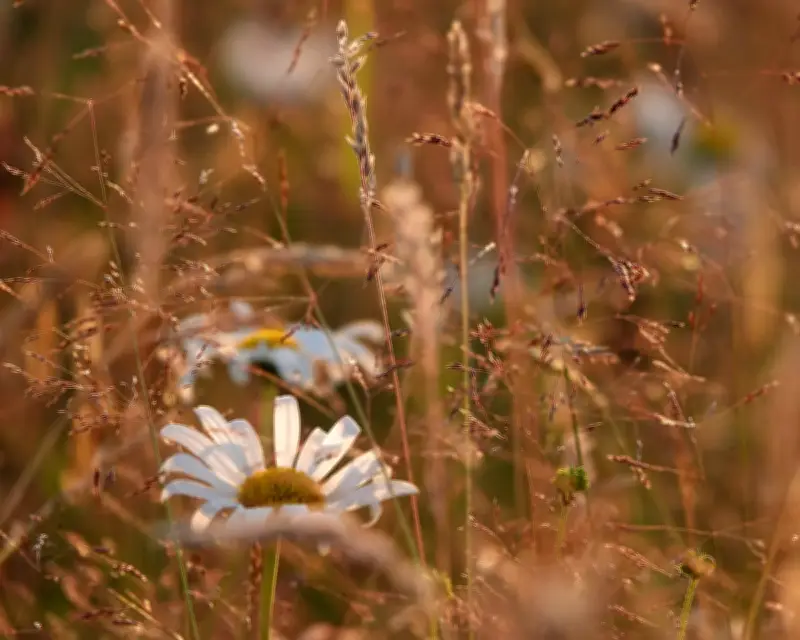
A small tableau from the circuit at the site captures this: a spot where oxeye daisies and common knapweeds mingled equally in a knee-high horizon of snowdrift white and dusky evening-pink. The blooms were at a ratio of hundreds per square metre and thousands per single photographic frame.

Complex Reticulation of Stalks and Stems
They recessed as a blended whole, but also as individual plants, radiating outwards, negotiating each other's presence in a reticulation of stalks, stems, blooms, or leaves so complex one could burst from any effort to comprehend it. It was magnificent, but almost overwhelming. The right response might not be to reckon with it, but to drop down before it.
Echoes of Edward Thomas's Haymaking
One detail in Thomas's Haymaking meadow is also at this Derbyshire Wildlife Trust reserve. In unforgettable lines, speaking of the grasses and weeds, the men and their beasts in the heat, Thomas wrote 'and all were silent. All was old.' So old, in fact, it seemed he was encountering not a living moment but something 'immortal in a picture'. He is inaccurate in one specific sense: no image can be older than life, which has a lineage of 3.8bn years. Somehow, in a flower-rich meadow, one becomes aware that you and the flowers are party to it all.