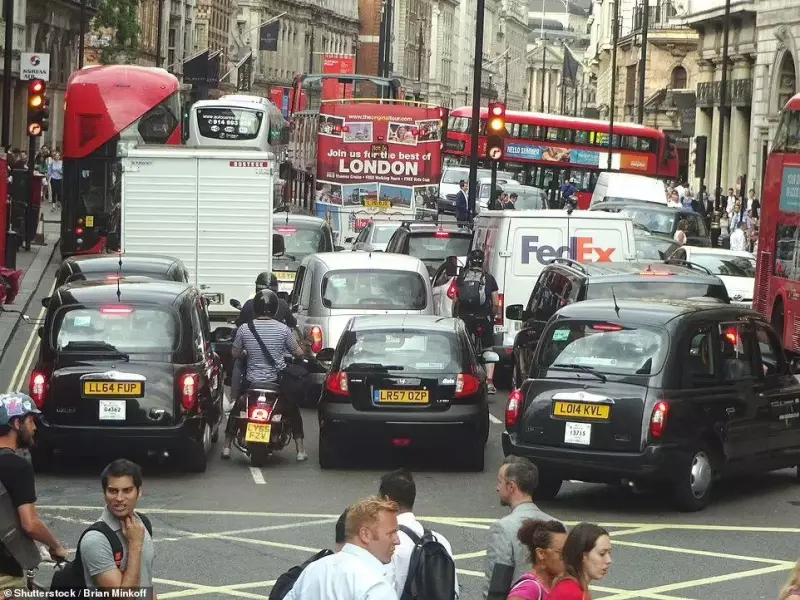
If you've ever been kept awake by the relentless hum of city life, new research confirms you are far from alone. A comprehensive study has identified the areas across the United Kingdom where residents are most affected by noise, crowning the City of Westminster as the nation's undisputed loudest spot.
The Methodology Behind the Decibels
The analysis, conducted by the company The Soundproof Windows, compiled a mix of public data and internal research to create an overall noise score for numerous UK cities. The model evaluated several key factors linked to everyday urban soundscapes, weighting each differently in the final calculation. These factors included the rate of noise complaints, the density of nightlife venues and industrial sites, population density, general city activity levels, and construction work.
Westminster emerged at the top of the rankings with a commanding total score of 56.65. This result was primarily driven by two overwhelming statistics: an exceptionally high rate of noise complaints, recorded at 68.10 per 1,000 people, and an extreme population density of 11,533 residents per square kilometre. While its nightclub density is a relatively modest 3.63 per 10,000 residents, the area's significant industrial density (145.8 per km²) and its status as a constant hub of activity solidified its position as the UK's noisiest location.
Surprising Contenders and the Sources of Their Sound
The study revealed that smaller cities can generate surprising levels of noise. Securing second place with a score of 48.79 was Wells. Its high ranking stems not from complaints, which are low, but from a formidable industrial density of 246.9 per km² and one of the country's busiest construction rates, with 224.32 permits per 10,000 residents.
In third place was Chichester, scoring 35.71. Its noise profile is a blend of industrial activity (87.2 per km²), ongoing construction (192.01 permits), some nightlife (5.36 nightclubs per 10,000 residents), and a population density of 2,391.75 per km².
The middle of the top ten list shows how different elements combine to create noisy environments. Durham (34.09) derives much of its noise from long average commute times and heavy construction activity. Lichfield (29.85) mixes nightlife with population density and construction, while Southampton (28.36) is heavily affected by its packed population of over 19,000 people per km².
Traffic, Nightlife and Crowded Streets
The lower half of the top ten illustrates the impact of bustling city life. Newcastle upon Tyne (28.20) scores due to its nightlife and crowded streets. Hereford (28.08) feels the impact of long commutes and local industry. Kingston upon Hull (27.86) combines a notable share of complaints with nightlife, and Manchester (27.84) is profoundly affected by its immense population density, which keeps background traffic and city noise at a constant level.
The research, which was first published on 18th December 2025 and updated on 19th December 2025, provides a detailed snapshot of the acoustic challenges facing urban dwellers. The full list of the fifty-four areas analysed, complete with their scores across all measured metrics, offers a clear picture of where noise pollution is most acute in the UK.