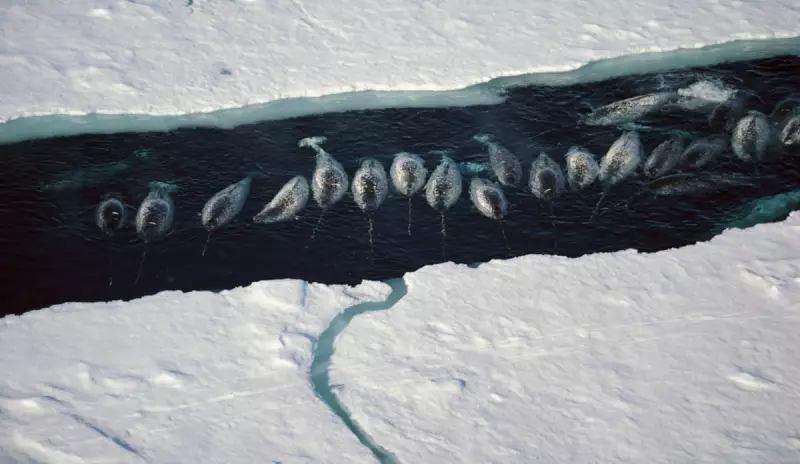
The delicate acoustic world of narwhals in Canada's eastern Arctic is being increasingly disrupted by the growing rumble of shipping traffic, according to new research that confirms what local Inuit communities have long observed.
Silenced by Sound
In the quiet waters of Eclipse Sound, off Baffin Island in Nunavut, narwhals' intricate clicks and whistles used for navigation and communication are being drowned out by passing vessels. Research conducted in 2023 and published this year documented how the approach of the 225-metre Nordic Odyssey ice-class bulk carrier creates a wall of sound that causes the tusked whales to fall silent or move away.
Alexander James Ootoowak, an Inuk hunter from Pond Inlet who worked as a field technician on the research team, confirms this behaviour. "Narwhals stop calling or move away from approaching vessels when they hear them," he states.
The study deployed hydrophones in this crucial shipping corridor that forms part of the Northwest Passage, capturing how the whales' acoustic signals, evolved for one of Earth's quietest environments, become useless against ship noise.
Global Problem, Local Impact
This isn't an isolated issue. Marine biologist Lindy Weilgart from Halifax emphasises the widespread nature of the problem: "I have yet to find any marine species that is completely immune to noise or vibration of any kind."
The research adds to mounting evidence that underwater radiated noise – sound energy emitted through ship hulls, propellers and machinery – disrupts marine life globally. In Pacific waters, southern resident orcas lose their salmon-hunting abilities in ship noise near Vancouver. In the Atlantic, North Atlantic right whales showed reduced stress levels when ship traffic temporarily ceased after the 9/11 attacks.
What makes shipping noise particularly concerning, according to experts, is that unlike seismic surveys or windfarm construction, ships gain nothing from making noise – it represents wasted energy that could be reduced through better design.
The Push for Quieter Solutions
This November, the International Maritime Organization Assembly will see the High Ambition Coalition for a Quiet Ocean – comprising 37 countries representing over 50% of the global shipping fleet – calling for new policies focused on designing and operating quieter ships.
Michelle Sanders, director general of the Innovation Center at Transport Canada in Ottawa, stresses the urgency: "We need to bring everybody together to work toward a solution that will reduce the sound in our ocean to protect marine species."
Practical solutions already exist. Giorgio Burella, a naval architect at Robert Allan, explains that vessels can incorporate advanced propeller designs that reduce cavitation bubbles, hull modifications for smoother water flow, and engine isolation systems to prevent vibrations transmitting into surrounding waters.
Success stories are emerging. The Enhancing Cetacean Habitat and Observation (Echo) programme in Vancouver achieved a 60% voluntary participation rate in noise reduction measures, cutting noise in half in critical orca habitats. Programme manager Melanie Knight notes this later increased to 90%, with additional benefits including reduced air emissions and lower collision risks for marine mammals.
Back in the Arctic, Baffinland Iron Mines Corporation has incorporated the world's first Silent-E designated bulk carrier, the Nordic Nuluujaak, into its fleet servicing the Mary River mine. The company has also implemented convoy operations, nine-knot speed limits, and fixed shipping routes to reduce cumulative noise exposure.
However, oceanographer Joshua Jones from Scripps Institution of Oceanography cautions that even ships operating below quiet certification standards can still disrupt highly sensitive species like narwhals. The Eclipse Sound research confirmed narwhal vulnerability at distances of 20 kilometres, far exceeding the 3-kilometre range previous studies had predicted.
As Alexander James Ootoowak concludes, comprehensive noise management requires accountability across all vessel types – from cruise ships to fishing boats – because in the acoustic world of narwhals, every engine matters.