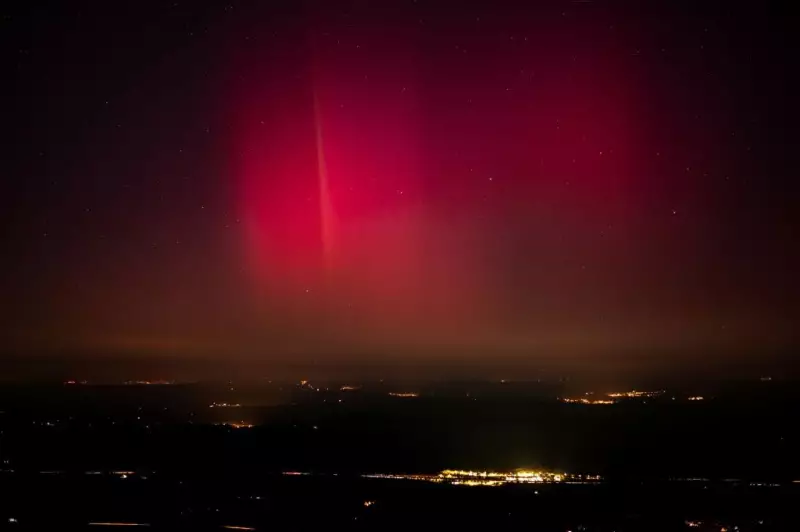
Skygazers across the United Kingdom are in for a potential treat as the Northern Lights are forecast to be visible far further south than usual on Wednesday night. This dazzling celestial display, however, comes with a side effect: a powerful geomagnetic storm that could disrupt some technologies.
Why the Aurora is Appearing Over Britain
The spectacular light show is the result of a celestial bombardment. Three significant coronal mass ejections (CMEs)—enormous bursts of plasma from the Sun—are reaching Earth this week. Two arrived on Tuesday night, 11th November, with the third expected on Wednesday, 12th November.
These charged particles, travelling at millions of kilometres per hour, are now interacting with Earth's magnetic field. This collision 'excites' molecules in our atmosphere, such as oxygen and nitrogen, causing them to release energy in the form of light. This fundamental process is what creates the beautiful, shifting colours of the aurora.

Understanding the Geomagnetic Storm
The Met Office's space weather department has issued a G4 to G5 geomagnetic storm watch, effective from Wednesday noon through to midnight on Thursday. A G4 storm is classified as 'severe', while a G5 is considered 'extreme'.
While these storms pose no direct danger to human health, they can have technological consequences. Potential impacts include disruptions to radio and GPS signals. In the most extreme scenarios, there is a possibility of damage to transformers, which could lead to localised power cuts. For most people in the UK, the storm will pass unnoticed, save for the incredible visual spectacle it produces.
How to Spot the Northern Lights
The enhanced auroral activity is predicted to last into Thursday morning, offering a wide window for potential sightings. The Met Office indicates that the aurora could be visible across the entire country, though the best chances remain in the north.
The main challenge for hopeful viewers will be the weather. Cloud cover is expected to inhibit viewing conditions for many, with forecasts showing heavy bands of cloud over Northern Ireland, southern Scotland, and parts of northern England. However, clearer skies are anticipated at times in far northern Scotland, the south east of England, Wales, and the English midlands.
To maximise your chances, follow this expert advice:
- Wait until after dark, which falls early at this time of year.
- Seek out a location with very dark skies, far from street lights and other light pollution.
- Face north for the best potential view.
- The prime viewing window is generally between 10pm and 2am.
- If you cannot see the lights with your naked eye, try using your smartphone camera, as its sensor is often more sensitive to the aurora's colours.
With a bit of luck and clear skies, Britons could be treated to one of nature's most breathtaking displays.