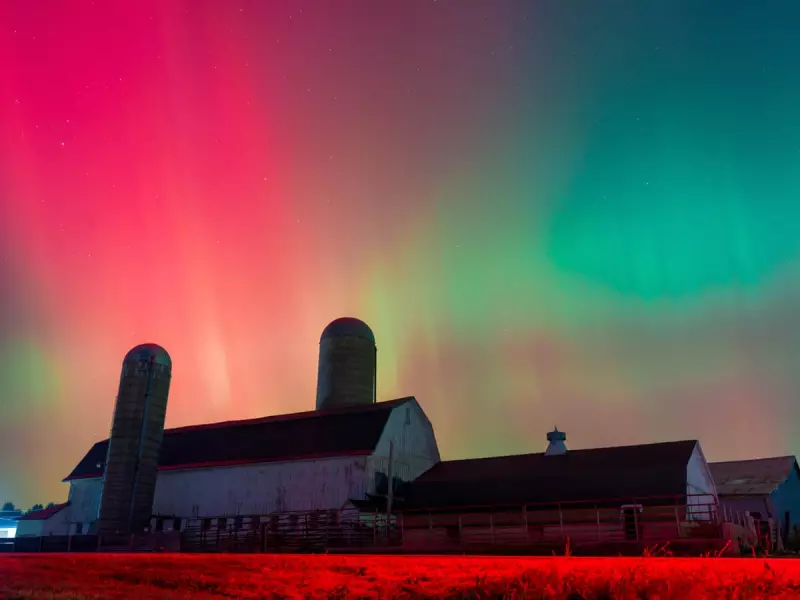
A spectacular celestial display illuminated the night sky across an unprecedented swathe of the United States, as one of the most potent solar storms in decades triggered vivid auroral activity. The aurora borealis, or northern lights, was witnessed from coast to coast on the night of 11 November 2025, with sightings reported in over a dozen states.
A Coast-to-Coast Celestial Spectacle
The phenomenon was driven by a severe G4 geomagnetic storm, the second-highest rating on the scale used by the US National Oceanic and Atmospheric Administration (NOAA). This event was caused by coronal mass ejections (CMEs)—massive eruptions of solar material—hurled from the sun towards Earth. Shawn Dahl, a forecaster at NOAA's Space Weather Prediction Center (SWPC) in Boulder, Colorado, confirmed that the initial CMEs had "packed quite a punch" and surpassed expectations with their intensity.
Social media was quickly flooded with stunning photographs of the glowing, colourful skies. Reports and images of the aurora poured in from a remarkable range of locations, including New York, Texas, Tennessee, Washington state, Florida, California, Georgia, and even as far south as Alabama and Louisiana.

The Science Behind the Light Show
The aurora borealis occurs when charged particles from the sun travel through space and collide with gases in Earth's upper atmosphere. These interactions excite the gases, causing them to emit light of varying colours, most commonly green and pink. The strength of the incoming solar particles dictates how far south the auroral oval can expand, which explains why this powerful storm made the lights visible across such unusually low latitudes.
By Wednesday morning, forecasters reported that the geomagnetic storm had subsided to G3 conditions but warned that activity could intensify again. A third and potentially final CME was anticipated to arrive around midday ET on 12 November. NOAA forecasters described this third ejection as likely the "final and most energetic" of the three.
Will the UK See a Repeat Performance?
While the main event was focused over North America, the global nature of such space weather events means that observers in the UK were also on high alert. Meteorologist Marc Chenard suggested that auroral activity could be visible again on Wednesday night, though cloud cover in regions like the Northeast and West Coast of the US might obstruct the view.
For stargazers in the UK, particularly in northern Scotland and areas with minimal light pollution, powerful solar storms like this one offer the best chance to witness the northern lights. The SWPC advised that G4 conditions with a chance for higher levels remained possible throughout the day, offering a potential encore for those who missed the initial display.