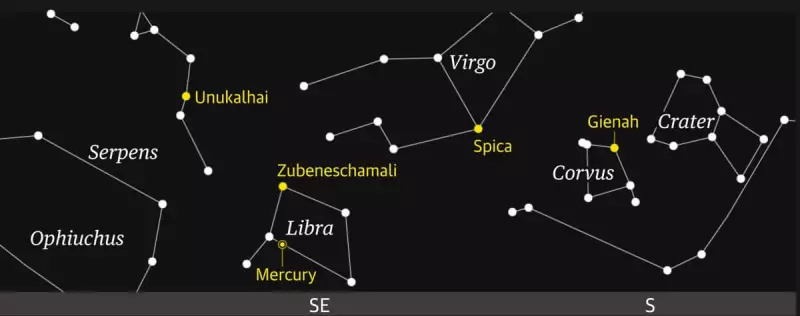
Skywatchers across the United Kingdom are in for a celestial treat this December, with one of the finest opportunities of the entire year to spot the elusive planet Mercury. The innermost world, often hidden in the sun's glare, is making a favourable pre-dawn appearance for observers in the northern hemisphere.
A Prime Planetary Alignment
This week, Mercury reaches an orbital position astronomers call the greatest western elongation. This crucial configuration means that, from our vantage point on Earth, the planet appears at its maximum angular distance from the sun in the morning sky. For those at mid-northern latitudes, including the UK, the viewing geometry is particularly advantageous.
The optimal viewing window falls in the 30 to 60 minutes before sunrise. During this brief period, Mercury will shine unmistakably bright low in the south-eastern sky. As twilight brightens, stars will gradually fade from view, but the resilient planet will remain visible, the last pinpoint of light to succumb to the daylight.

How and When to See Mercury from the UK
For observers in London, the view looking south-east at 7:00 AM GMT on Saturday, 7 December will be the prime moment. While the planet will be low on the horizon, its brightness should make it relatively easy to identify with the naked eye in clear conditions.
The spectacle presents a significant challenge for viewers in the southern hemisphere, where Mercury will be barely visible. For UK-based enthusiasts, a clear, unobstructed view of the eastern horizon is essential. While binoculars can aid in initially locating the planet, it is critically important not to use them anywhere near sunrise. Accidentally catching even a fleeting glimpse of the sun through optics can cause permanent eye damage.
A Fleeting Opportunity for Early Risers
This event underscores Mercury's reputation as a challenging planet to observe. Its orbit close to the sun means it is usually lost in solar glare, making these periods of elongation—occurring only a few times each year—the best chances for observation. The December morning elongation is often the most favourable for northern hemisphere observers due to the angle of the ecliptic relative to the horizon.
This rare astronomical event offers a compelling reason for early risers to brave the winter chill. Witnessing Mercury, a world of extreme temperatures and a tenuous atmosphere, shining steadily in the twilight, provides a direct and beautiful connection to the dynamic mechanics of our solar system.