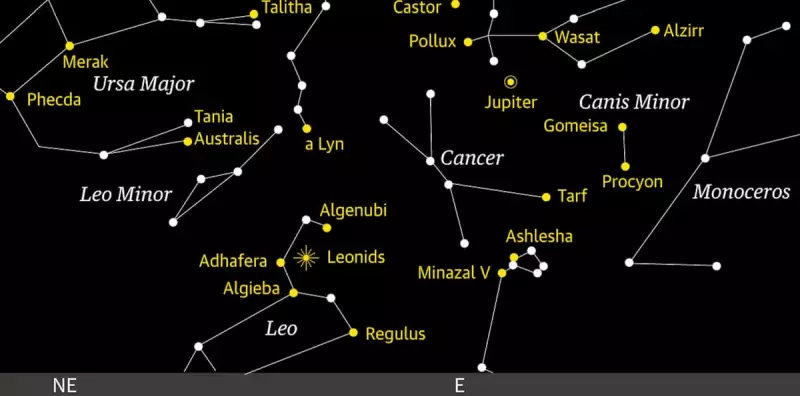
One of the year's most dependable celestial displays is set to illuminate British skies this week as the Leonids meteor shower reaches its spectacular peak.
When and Where to Watch the Leonids
The meteor shower will hit its maximum intensity during the night of November 16-17, offering prime viewing conditions for astronomy enthusiasts across the United Kingdom. Active throughout November and into early December, the Leonids are renowned for their reliability and bright displays.
For observers in the northern hemisphere, including all of the UK, the optimal viewing window falls during the early morning hours when the constellation Leo climbs higher in the sky and darkness reaches its deepest point. The chart indicates the eastern sky view from London at midnight as November 16 transitions into November 17.

What Makes the Leonids Special
These celestial travellers derive their name from the constellation Leo, specifically appearing to radiate from the area known as the 'lion's head' - an asterism called the sickle due to its distinctive curved shape.
The meteors themselves are remnants from comet 55P/Tempel-Tuttle, creating approximately 10-15 bright meteors per hour during the peak period. These are particularly fast-moving particles, entering Earth's atmosphere at staggering speeds of around 70 km per second.
Their incredible velocity results in straight, luminous trails that often linger visibly in the atmosphere after the meteor itself has vanished. While the Leonids have historically produced meteor storms with thousands of visible meteors per hour, astronomers don't anticipate such an outburst for the 2025 display.
How to Get the Best View
Successful meteor watching requires some preparation. Experts recommend wrapping up in warm clothing, as November nights can be chilly. Bringing a deck chair will make your observation session more comfortable, allowing you to look upward without straining your neck.
Patience proves essential when watching meteor showers. Find a location with minimal light pollution, settle into your chair, and allow your eyes at least 20 minutes to adjust to the darkness. Remember that meteor showers often come in bursts, so don't be discouraged by quiet periods.
While the Leonids won't produce a storm this year, their consistent performance and bright meteors make them one of the most rewarding astronomical events for both seasoned stargazers and newcomers to astronomy alike.