
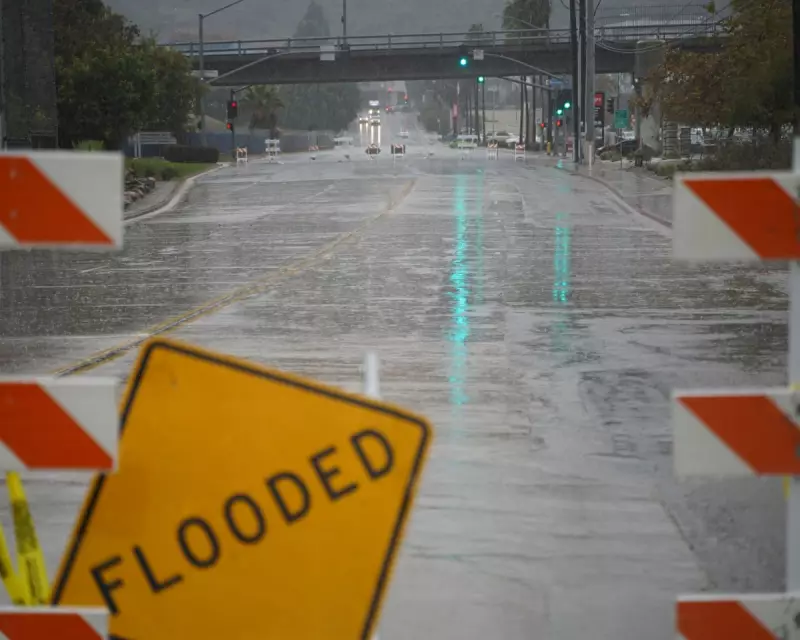
A powerful rainstorm has unleashed chaos in San Diego, disrupting holiday travel and forcing hundreds of the city's most vulnerable residents to flee a flooded homeless shelter as the new year began.
Record Rainfall Triggers Emergency Evacuation
On New Year's Day, a severe storm dumped approximately 2in (5cm) of rain on San Diego, breaking local records and prompting multiple water rescues. The intensity of the downpour, equivalent to a typical month's rainfall, led officials to evacuate the Bridge shelter, a large tented facility in the city's downtown.
About 325 men and women were hurriedly moved to a gymnasium in a nearby park for safety. This marked the third evacuation of the shelter in just seven years, with similar incidents occurring in 2018 and 2024.
"Not a great start to the new year," remarked Bob McElroy, CEO of the Alpha Project, the non-profit operating the shelter. The storm ravaged the property at a critical time, exacerbating an existing shortage of beds for those in need of shelter.
A Wider Pattern of Climate-Fuelled Disruption
The deluge in Southern California is part of a series of heavy winter storms that prompted Governor Gavin Newsom to declare a state of emergency. The region remains vulnerable, having been devastated by wildfires less than a year ago. The National Weather Service issued flood watches, warning that areas near recent burn scars were at high risk of flash flooding and debris flows.
Experts directly link the increasing frequency of such extreme weather events to climate change. Recent research underscores that people experiencing homelessness are disproportionately affected by these disasters. "We're definitely seeing more homelessness, more housing disruption, as a result of these disasters," Steve Berg of the National Alliance to End Homelessness told NBC News in 2023.
These events create a vicious cycle: they reduce the overall housing supply, making it even harder for those who lose their homes to find affordable alternatives. According to the Internal Displacement Monitoring Centre, 11 million people in the United States were displaced by natural disasters in 2024 alone.
The Human Cost of Recurring Disaster
The impact on individuals is profound and repeated. One shelter resident described wading through waist-deep water during the 2024 flood, stating, "It takes a lot to scare me, and that scared me." Yet, amidst the disruption, resilience persists.
Michael Coats, 68, who evacuated with his wife, maintained a determined optimism. "I call him God," Coats told a local broadcaster. "It gives me my inspiration to keep trudging through this... to where I will end up one day" reunited with his wife in a home of their own.
The situation in San Diego reflects a broader, troubling trend. A report from Georgetown Environmental Law Review notes that disasters displace both housed and unhoused people. While temporary measures can address immediate evacuation needs, the permanent loss of housing stock creates long-term scarcity. This was starkly illustrated in Maui, Hawaii, where homelessness surged by 83% following devastating wildfires in 2023.
As extreme weather becomes more commonplace, the crisis highlights the urgent need for resilient infrastructure and housing policies that protect society's most at-risk populations from the escalating impacts of a changing climate.



