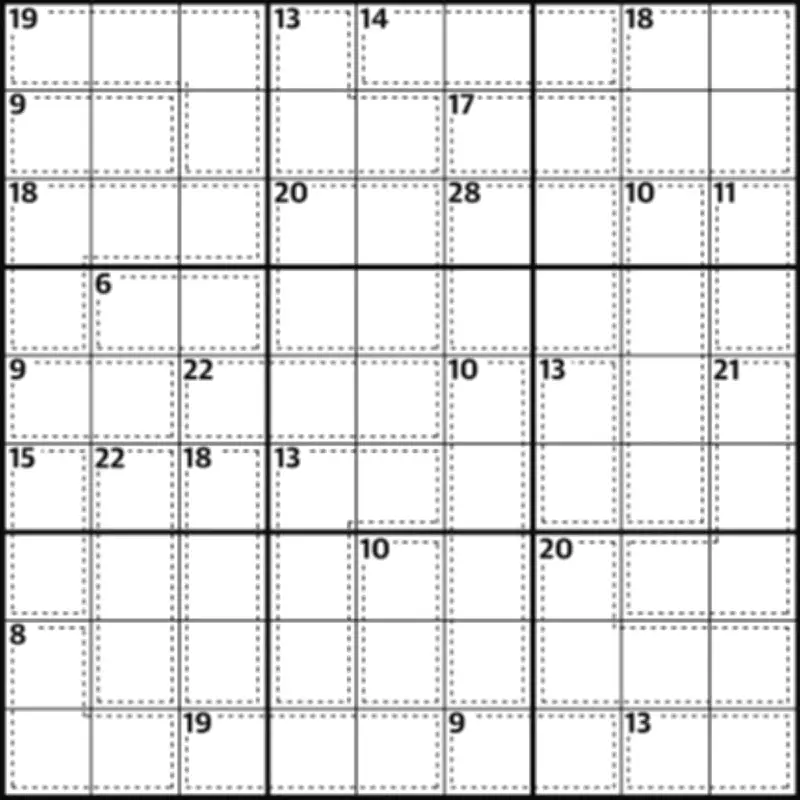
Killer Sudoku presents a thrilling twist on the classic number puzzle, blending logic and arithmetic into a uniquely challenging experience. Unlike traditional sudoku, this variant introduces additional layers of complexity that captivate enthusiasts and newcomers alike.
Understanding the Core Rules of Killer Sudoku
Normal sudoku rules remain firmly in place: each row, column, and 3x3 grid must contain the digits 1 through 9 exactly once. However, Killer Sudoku incorporates a distinctive mechanic involving dotted lines that define specific shapes across the puzzle board.
The Dotted-Line Mechanic and Sum Requirements
Within these dotted-line enclosures, the numbers placed in the cells must add up precisely to the figure displayed in the corner of that shape. This arithmetic constraint introduces a strategic element, as solvers must balance row, column, and grid requirements with these sum targets.

A critical rule prohibits repeating any number within a single dotted-line shape, even if the standard sudoku rules would otherwise allow it. This restriction demands careful planning and deduction, often requiring solvers to consider possible number combinations that meet both the sum and uniqueness criteria.
Accessing Print Versions and Solutions
For those who prefer a tactile solving experience, print versions of these puzzles are readily available. The Guardian publishes Killer Sudoku puzzles regularly, with solutions provided in subsequent editions to aid learning and verification.
- Puzzles published from Monday to Thursday have their completed versions revealed in the next issue of the Guardian.
- Friday and Saturday puzzles feature solutions printed in either Saturday’s or Monday’s edition, ensuring solvers can check their work promptly.
This structured release schedule supports a consistent puzzle-solving routine, allowing enthusiasts to engage with new challenges while reviewing past attempts.
Strategies for Solving Killer Sudoku
Effective solving often begins with identifying shapes that have particularly high or low sum totals, as these limit possible number combinations. For instance, a shape summing to 3 can only contain 1 and 2, immediately revealing those digits’ placements if the shape has two cells.
Advanced solvers frequently use cross-referencing techniques, where the constraints of one shape inform possibilities in overlapping rows, columns, or grids. This interconnected approach leverages the puzzle’s dual nature, blending sudoku’s logical deductions with arithmetic insights.
Practicing regularly enhances pattern recognition and speed, making even the most complex puzzles manageable over time.
The Role of Killer Sudoku in Cognitive Engagement
Beyond entertainment, Killer Sudoku offers significant mental benefits. It sharpens logical reasoning, improves numerical fluency, and fosters problem-solving skills. The puzzle’s unique rules encourage flexible thinking, as solvers must adapt strategies to meet both traditional and arithmetic constraints.
As part of the broader sudoku family, Killer Sudoku maintains accessibility while providing depth for those seeking greater challenges. Its popularity underscores a growing interest in puzzles that combine multiple cognitive disciplines.
Whether tackling a daily puzzle or exploring advanced techniques, Killer Sudoku remains a rewarding pursuit for minds of all levels.