Jupiter's Steady Glow Dominates Gemini in February's Night Sky
Throughout this month, Jupiter has maintained its prominent position in the constellation Gemini, known as the Twins, serving as a reliable reference point in the evening sky. This celestial display is set to continue into March, providing stargazers with an ongoing opportunity to observe the solar system's largest planet. Jupiter shines with such brilliance that it easily cuts through urban light pollution, making it a straightforward target for observation even in city environments.
Identifying Gemini and Its Key Stars
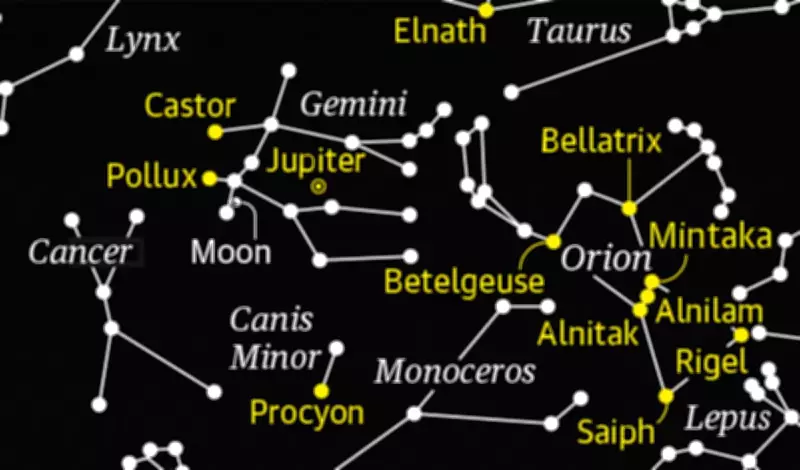
Gemini is primarily identified by its two principal stars, Castor and Pollux, which mark the heads of the twins. During February, Jupiter is situated between and slightly south of these stars, outshining them both with its luminous presence. This positioning creates a striking visual trio that enhances the constellation's appeal.
Why Planets Like Jupiter Do Not Twinkle
Unlike stars, planets such as Jupiter are relatively close to Earth, which means their light is less affected by atmospheric distortion. This results in a steady, non-twinkling appearance that helps distinguish them from the surrounding star fields. As a result, Jupiter stands out as a consistent and unwavering beacon in the night sky, offering a clear point of reference for astronomers and enthusiasts alike.

Tracking Jupiter's Motion and Celestial Mechanics
Jupiter's gradual motion against the fixed stars can be tracked night after night, reflecting both its own orbit around the sun and Earth's motion. By comparing Jupiter's position relative to Castor and Pollux over successive weeks, observers can detect this subtle shift. This movement provides a fascinating glimpse into the solar system's celestial clockwork, illustrating the dynamic nature of our cosmic neighborhood.
Upcoming Celestial Events and Viewing Tips
The chart included with this article shows the view high in the south-south-east from London at 7pm on Friday, February 27th, when the grouping is joined by the waxing gibbous moon. This alignment offers an enhanced viewing experience, making it an ideal time for observation. For those interested in further exploration, topics such as science, starwatch, space, and Jupiter features provide additional context and insights into this astronomical phenomenon.