
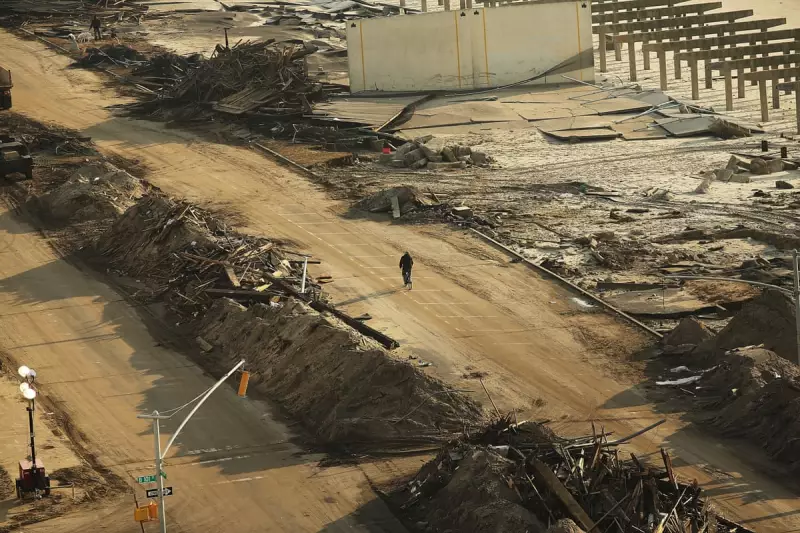
Thirteen years after Hurricane Sandy unleashed its fury on New York City, the working-class neighbourhood of Edgemere in Queens remains dangerously exposed to rising waters, with residents claiming they've been abandoned by the very officials who promised protection.
A Community Left Behind
Baba Ndanani has called Edgemere home for more than two decades, but his memories of the 2012 superstorm remain vivid. Over five feet of water surged into his two-storey home during the hurricane, forcing him to swim across the street to higher ground where he sheltered in a disabled car surrounded by floodwaters.
"I was praying," Ndanani recalled. "I just wanted to get out, and that was it." When he returned to his devastated property, he spent two weeks sleeping atop an overturned refrigerator.
Despite this traumatic experience and a city-run voluntary buyout programme designed to relocate residents from vulnerable areas, Ndanani and many of his neighbours have chosen to stay, still hoping the city will deliver on its decade-old promise to protect their community.
The Resilience Divide
While Lower Manhattan benefits from the ambitious £2.1 billion Big U project - a 10-mile-long flood protection system featuring raised shorelines and massive floodgates - Edgemere's bayside remains completely unprotected.
"In the other neighbourhoods they've done that, so why is Edgemere different?" Ndanani asked pointedly. "Because we don't have Wall Street here?"
This disparity reflects a troubling national pattern. From Charleston to Miami to Norfolk, city officials are planning billion-dollar seawalls to protect wealthy urban cores while leaving vulnerable, often minority communities like Edgemere exposed.
Edgemere's geography makes it particularly susceptible to flooding. The low-lying neighbourhood sits on the Rockaway peninsula, flanked by the Atlantic Ocean on one side and Jamaica Bay on the other. During Sandy, water rushed in from both directions, filling streets with nearly six feet of water.
"The ocean and the bay were one and the same," remembered long-time resident Sonja Webber-Bey. "So whatever was in your house was the ocean and the bay."
Broken Promises and Empty Lots
In 2015, the city launched the Resilient Edgemere Community Planning Initiative with great fanfare. The plan promised reduced flood risks and affordable housing. While some improvements materialised - including drainage upgrades, elevated homes and a rebuilt boardwalk - the crucial bayside protection feature was quietly abandoned.
"Edgemere, especially the portion towards the bay, is still highly vulnerable," explained Veronica Olivotto, a researcher from The New School who studied flood risk mitigation in the area. "If a superstorm were to happen next month, the same exact issues would occur."
Resident Jackie Rogers expressed the community's frustration: "It's 13 years since superstorm Sandy, and yet still no flood mitigation on the bayside. We are forgotten here."
Michael Sandler, associate commissioner at the NYC Department of Housing Preservation and Development, acknowledged the delays. "I understand the frustration of Edgemere residents," he said, citing staffing changes and pandemic-related funding losses as contributing factors.
Sandler recognised the ongoing vulnerability, particularly during hurricane season: "There isn't a coastal protection feature, and I think that residents in the neighbourhood are right to be concerned about what the future looks like."
New Housing in Harm's Way
Despite the lack of flood defences, the city has approved construction of new affordable housing towers in Edgemere, all located within floodplains. Sea level rise projections indicate these buildings could be partially underwater by 2100.
Officials defend the decision by stressing the city's acute need for affordable housing and noting that taller buildings will be less flood-prone than existing one- and two-storey homes. However, Olivotto raises concerns about evacuation challenges, with only one main road and one subway line serving the area.
"I think the idea of bringing new homes to Edgemere needs to be rethought," she cautioned.
This continuation of concentrating low-income residents in vulnerable coastal areas follows a nearly century-old pattern beginning with infamous city planner Robert Moses, resulting in thousands of working-class New Yorkers living in flood-prone zones.
The city's current strategy relies on a federal Army Corps of Engineers project to protect Edgemere's bayside, but the initiative has remained in the design phase for years. With uncertain federal commitment to climate resilience projects, few residents expect protection anytime soon.
"These are really big, complicated projects," Sandler admitted, "and the city does not have the full resources for all of the coastal protection projects that are necessary to protect the city from climate change."
As climate change intensifies and sea levels continue to rise, Edgemere stands as a stark example of the difficult choices facing coastal communities worldwide - and the communities being left behind in the process.



