
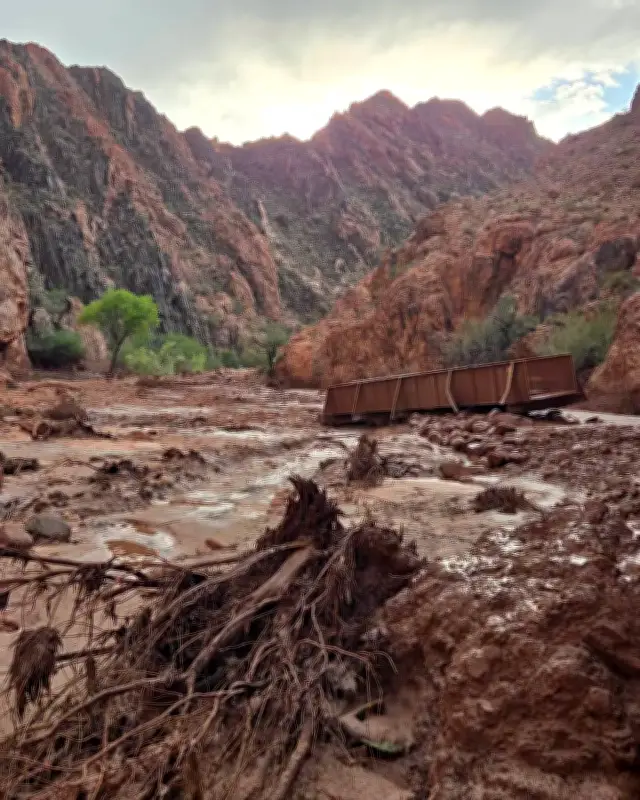
A catastrophic flash flood swept through the Grand Canyon on Saturday, killing at least two people and leaving 15 others missing or unaccounted for, according to park officials. The surge of water and debris struck the popular Bright Angel Creek area after torrential rains pounded the arid landscape, a disaster likely amplified by a combination of climate factors, including drought, wildfire scarring, and El Niño-driven warming in the Pacific Ocean.
Deadly flash flood hits popular tourist destination
The flood occurred on August 30, 2025, when intense thunderstorms unleashed heavy rain over the narrow canyon formations, funneling water rapidly into a charging wall of debris. Flash floods are a known hazard in the region, especially during the monsoon season from June to September, but the severity of this event caught many off guard. Hikers had to be evacuated by helicopter after rushing waters swallowed bridges and other infrastructure, with witnesses reporting that Bright Angel Creek turned black as it filled with runoff.
Teams from the Department of Interior, tasked with assessing post-fire threats to “life, property, and critical natural and cultural resources,” had previously warned of heightened risks. In a report, they noted that runoff risks would be between two and eight times greater upstream of Phantom Creek, and that “hikers on the trails within or downslope from the burned area will experience frequent stabilization issues, especially hazardous rockfall for at least the first year.”
Wildfire scar and drought compound the danger
The storm hit part of the burn scar of the Dragon Bravo wildfire, a destructive blaze that swept across nearly 150,000 acres (60,700 hectares) and consumed the historic Grand Canyon Lodge in July 2025. Runoff tends to flow more quickly after a fire, especially in hotter burns where slopes are left barren of vegetation, increasing the risk of debris flows. Federal models indicated a rise in these risks in Bright Angel Creek, and park officials were reportedly concerned at the start of summer that stronger storms could create dangerous conditions near burned areas.
In addition to the fire's impact, a severe drought affecting the Grand Canyon region and the Colorado River basin likely contributed. The deluge fell on hardened, sparsely vegetated terrain that is less able to absorb abrupt increases in moisture, exacerbating the flash flooding.
El Niño and climate change intensify storms
The sudden, strong rainstorm may have been supercharged by the historic El Niño, which has sharply increased sea surface temperatures in the Pacific Ocean. This climate phenomenon affects weather systems worldwide; in the south-west, higher water vapor in the atmosphere due to El Niño is wrung out as rainfall, according to Park Williams, a hydroclimatologist at the University of California, Los Angeles, who spoke to the Associated Press. El Niño is part of a natural cycle, but models suggest this could become one of the strongest on record, layering on top of temperature spikes fueled by the climate crisis.
The link between human-caused climate change and the heavy Arizona rain is moderately strong, said Daniel Swain, a climate scientist at the California Institute for Water Resources. Swain and colleagues recently published a study in the journal Weather and Climate Extremes finding that summer short-term intense downpours in the US west have become 10% stronger since 2000. Scientists have long warned that the climate crisis will create stronger extremes and destructive shifts between wet and dry conditions, with so-called “compound extremes” on the rise, according to researchers.
The disaster underscores how overlapping factors—wildfire scars, drought, and ocean warming—can combine to produce calamity, testing the limits of the nation's resilience and recovery as search efforts continue for the missing.



