
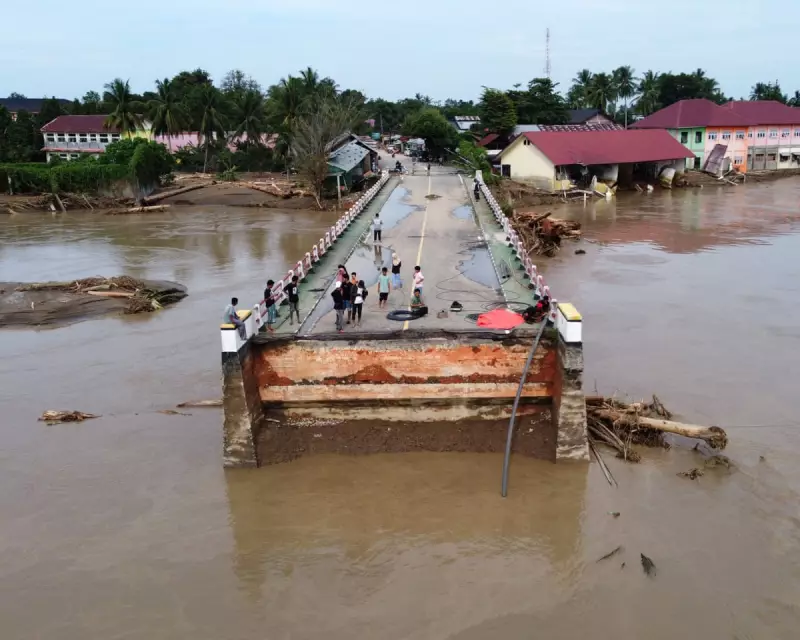
Torrential monsoon rains, supercharged by tropical cyclones, have unleashed catastrophic flooding across parts of Asia, killing more than 1,100 people and leaving a trail of destruction from Indonesia to Thailand. Survivors have described harrowing escapes from rapidly rising waters with currents so powerful they could 'kill an elephant', as entire communities were upended.
Escaping the Deluge: Personal Stories of Survival
In the Pidie Jaya district of Indonesia's Aceh province, 63-year-old Aminah Ali was at home when the rains began at midnight on Wednesday. Initially seeming like typical monsoon flooding, the situation turned catastrophic with a sudden roar of water. "I saw many houses being swept away," she said after spending 24 hours on her rooftop, surrounded by 3-metre-high floodwaters. Her home is now ruined and caked in mud, her possessions gone. "Now I only have one shirt left," she lamented.
Nearby, Busra Ishak, 60, lost his house completely to the force of the water. He survived by swimming to and clinging to a coconut tree for over 12 hours. "There were hundreds of tons of logs [in the water], and even an elephant could be killed by the incredibly strong current," he stated. Tragically, one of his older sisters was killed in the disaster.
System Failures and Miraculous Escapes in Thailand
In Southern Thailand, particularly the hard-hit city of Hat Yai, the failure of authorities to give adequate warning has been strongly criticised. Natchanun Insuwano and his parents were stranded in their flooded home, sharing just one bottle of water from Sunday 23 to Tuesday 25 November. He messaged every hotline and posted on social media for help, but none came. "I looked in the sky to see if a helicopter or drone might drop some food," he said. He eventually flagged down a rescue boat after shouting for help; his mother was carried out on a stretcher, weak and unconscious.
Another Hat Yai resident, 32-year-old Chutikan Panpit, believes it is a miracle she is alive. While checking water levels on her terrace, she was bitten by a highly venomous Malayan pit viper. Trapped by high waters for 32 hours, she endured pain worse than childbirth, sustained by thoughts of her one-year-old son. Rescuers told her to hold on tightly as they accelerated through the strong surges. "With this snake and 32 hours, people say either you die or have to amputate the leg," she said.
Immense Scale of Destruction and Daunting Recovery
The scale of the disaster is immense. On the Indonesian island of Sumatra alone, more than 600 people have been killed, with at least 11 bridges and sections of national highway cut off, leaving some villages completely inaccessible. In Thailand, the death toll stands at at least 176. Tens of thousands of homes across the region are damaged, with streets strewn with mud-caked debris.
While waters have receded in areas like Hat Yai, the sound of rain now induces panic. The recovery and clean-up operation is daunting. Many flood victims remain in rescue shelters, relying on community donors for food and water. Busra Ishak, now trying to salvage what he can, summarised the catastrophe: "This year's flood is the worst tragedy in history."



