
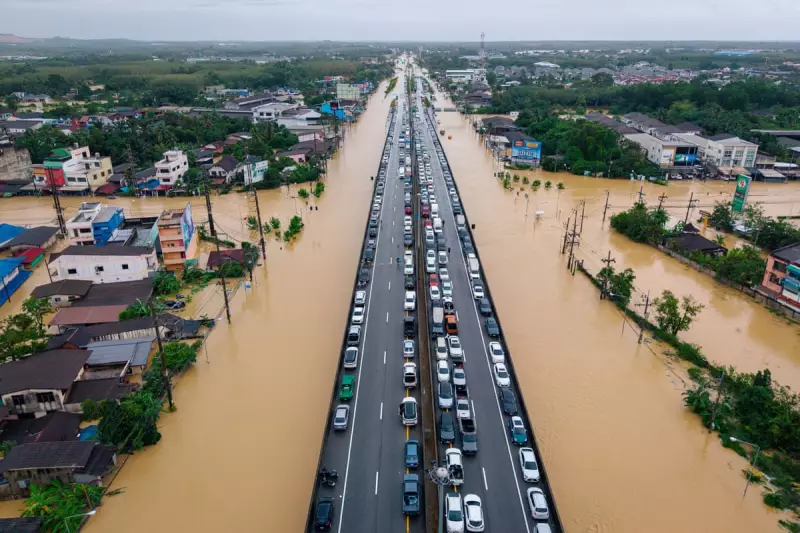
Catastrophic Flooding Claims Hundreds of Lives
Nearly 1,000 people have lost their lives across southern and south-eastern Asia after a devastating combination of tropical cyclones and heavy monsoon rains triggered widespread flooding and landslides. The extreme weather has laid waste to vast areas, leaving a trail of destruction and homelessness in its wake.
Indonesia Bears the Brunt of the Disaster
Indonesia's archipelago has been particularly hard hit, with the national death toll reaching 442 people following floods that began around a week ago. Authorities fear this number is likely to rise further. The disaster has displaced close to 300,000 individuals and damaged almost 3,000 houses, with 827 of them completely flattened or swept away.
On the island of Sumatra, desperate scenes unfolded as residents scrambled for essential supplies. Social media videos depicted people navigating crumbling barricades, flooded roads, and broken glass to secure food, medicine, and fuel. Many were forced to wade through waist-deep water to reach damaged shops.
Police spokesperson Ferry Walintukan confirmed that regional police were deployed to restore order. He explained that the looting occurred before logistical aid could arrive, stating, "[Residents] didn't know that aid would come and were worried they would starve."
Sri Lanka's Worst Natural Disaster in Decades
In Sri Lanka, the situation is equally dire. The death toll from floods and landslides triggered by Cyclone Ditwah rose sharply to 334 on Sunday, according to the country's disaster agency. Nearly 400 people remain missing.
The Disaster Management Centre (DMC) reported that more than 1.3 million people have been affected by the record-breaking rains. This event marks the worst natural disaster to strike Sri Lanka in two decades. The full extent of the damage in the central region is only now becoming clear as relief workers clear roads blocked by mudslides and fallen trees.
Low-lying areas flooded over the weekend, prompting authorities to issue evacuation orders for those living near the Kelani River. Thousands of police and military personnel are involved in a major relief operation, distributing food and moving trapped families to safety. Nearly 148,000 people have been displaced and are now housed in temporary shelters.
President Anura Kumara Dissanayake, who declared a state of emergency, addressed the nation, vowing to rebuild with international support. He said, "We are facing the largest and most challenging natural disaster in our history. Certainly, we will build a better nation than what existed before."
Rare Cyclone Formation Fuels the Crisis
Meteorologists attribute the severity of the rains to a rare meteorological event. The heavy seasonal rains were exacerbated by the formation of two tropical cyclones – Koto and Senyar. These cyclones turbocharged the rain systems by pulling in more warm, moist air.
Indonesia's meteorology agency noted that the formation of Senyar in the Strait of Malacca was a "rare" occurrence, though one that has become more frequent in the last five years. Andri Ramdhani from the Meteorology, Climatology, and Geophysics Agency (BMKG) explained that Indonesia's equatorial location typically makes it less prone to such cyclones, as areas near the equator lack the Coriolis force needed for storm development.
More broadly, experts point to the climate crisis as a factor affecting storm patterns, leading to heavier rainfall, stronger wind gusts, and more intense monsoon seasons.
Regional Impact: Thailand and Vietnam
The devastation has spread across the region. In Thailand, the Ministry of Public Health reported a death toll of 170 from flooding in the south, some of the worst seen in a decade. Songkhla Province suffered the highest number of fatalities at 131.
The city of Hat Yai in Songkhla received 372mm (14.6 inches) of rain on 21st November, its highest single-day total in 300 years. Authorities are facing public criticism over their flood response, and two local officials have been suspended for alleged failures.
In Vietnam, cyclone Koto claimed three lives after two boats sank amid strong winds and high seas along the central coast. Heavy rains have lashed central areas for weeks, flooding historic sites and popular holiday destinations, causing hundreds of millions of dollars in damage. Vietnam's weather bureau has forecast further heavy rains in regions only just recovering from historic floods.
According to national statistics, natural disasters have left more than 400 people dead or missing in Vietnam this year, with damage exceeding $3 billion.
Malaysia has also been affected, with two fatalities reported after floods submerged parts of northern Perlis state. Approximately 18,700 people remain in evacuation centres.



