
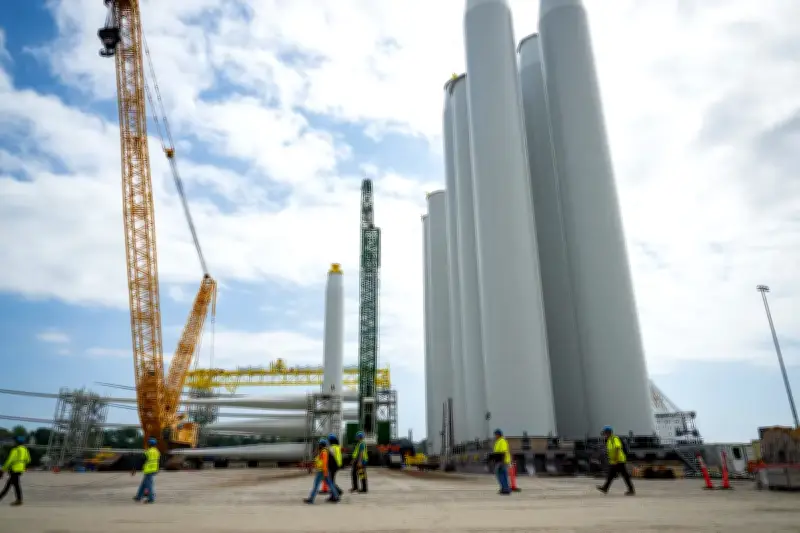
Union workers and labor leaders across the US are mobilizing against the Trump administration's efforts to halt offshore wind projects, defending the clean energy jobs and labor standards established under the Biden administration. The administration's stop-work orders have disrupted construction, but courts have blocked each order, allowing projects like Sunrise Wind, Empire Wind, and Revolution Wind to continue. Despite these legal victories, the administration's actions have had a chilling effect on future development, with projections for offshore wind capacity by 2035 dropping from 39 gigawatts to just 6 gigawatts.
Union workers' transition to offshore wind
Ryan McElroen, an electrician and member of the International Brotherhood of Electrical Workers (IBEW) Local 3, spent years repairing the New York City subway before transitioning to offshore wind. He has completed six one-month rotations on New York's first large-scale offshore wind projects: four on Sunrise Wind, about 30 miles east of Montauk Point, and two on Empire Wind in the New York Bight, 30 miles south of Long Island. McElroen described the change as a "welcome change," noting the opportunity to see seals and dolphins instead of rats, and to enjoy sweeping sunsets over the open ocean. He expressed a desire to continue this work for the rest of his career.
The Climate Jobs National Resource Center (CJNRC), founded by labor leaders including Mike Fishman, president and executive director, has worked for years to create unionized careers in clean energy. These efforts were bolstered by the Inflation Reduction Act (IRA) signed by President Biden in 2022, which provided incentives for clean-energy projects to meet prevailing-wage and apprenticeship requirements.
Building labor-climate coalitions
The CJNRC's origins trace back to New York after Hurricane Sandy in 2012, which served as a wake-up call for the labor movement. Fishman, then secretary-treasurer for the Service Employees International Union (SEIU), realized that workers were getting hit first and worst by climate change. At the time, climate groups focused primarily on emissions reduction, often without considering job quality. Lara Skinner, founding executive director of Cornell's Climate Jobs Institute, noted that climate groups touted potential jobs but did not focus on whether they would be high-quality or unionized.
Together, Fishman, Skinner, and members of the New York City Central Labor Council formed Climate Jobs New York, recruiting organizations representing 2.6 million workers. They pushed for a nine-gigawatt offshore wind buildout, which Governor Andrew Cuomo adopted in 2019, and the legislature enshrined in the Climate Leadership and Community Protection Act. In 2021, they secured strong labor and equity provisions for renewable energy, including prevailing wage and project labor agreement requirements.
Impact of the Inflation Reduction Act
The IRA provided a major boost to these efforts. John Podesta, climate and energy adviser to Biden and a CJNRC board member, said at a New York City convening that the IRA was fundamentally different because it supported good jobs and attached labor standards to private sectors for the first time. By September 2024, the Biden administration had approved 10 commercial-scale offshore wind projects totaling more than 15 gigawatts. By the end of 2024, the CJNRC had helped launch coalitions in nine states.
Chrissy Lynch, president of the Massachusetts AFL-CIO, said the IRA solidified the ability to work with environmentalist groups to fight climate change by creating good, family-sustaining jobs. Climate Jobs Massachusetts, which she chairs, worked with green groups to win climate legislation with labor standards for all future clean-energy projects.
Trump's attempts to halt offshore wind
Since re-election, President Trump has moved to dismantle Biden's climate agenda, targeting offshore wind with claims that it causes cancer, kills wildlife, and destroys property values. In 2025, the administration accelerated the phaseout of IRA clean-electricity tax credits and issued stop-work orders: first on Empire Wind in April, then Revolution Wind in August, and in December on Sunrise, Empire, Vineyard, and Coastal Virginia Offshore Wind. McElroen was on the job at Sunrise Wind when the stop-work order came down, noting that electricians were considered essential to prevent deterioration in the ocean.
In response, unions mobilized. Chris Erickson, business manager of IBEW Local 3, said they held press conferences and rallies to draw attention to the issue. In Rhode Island, workers and labor leaders opposed the halt to Revolution Wind, which threatened about 1,000 union jobs. Courts ultimately blocked each stop-work order, and projects continued.
Long-term damage and future outlook
Despite legal victories, the administration's actions have had a "complete chilling effect" on future offshore wind development, according to Erickson. The administration spent $2.7bn to cancel 12 offshore wind leases in five deals. BloombergNEF projected that the US would bring 39 gigawatts of offshore wind capacity online by 2035, but its October projections put that figure at just 6 gigawatts. Fishman noted estimates of a loss of 3bn work hours in the building trades. In New Jersey, several proposals have collapsed, leaving zero offshore wind activity despite thousands of IBEW members.
Erickson fears the damage will be long-lasting, making it harder and more expensive to restart the industry. However, unions have continued to notch climate wins, with CJNRC launching coalitions in five states and the United Kingdom this year. Fishman believes growth for offshore wind is inevitable due to its potential to generate large amounts of electricity near coastal demand centers. "The wind will change direction on offshore wind," he said, adding that the work done has set a different tone in the industry, with people now incorporating thinking on wages and jobs into their approach to new energy.



