
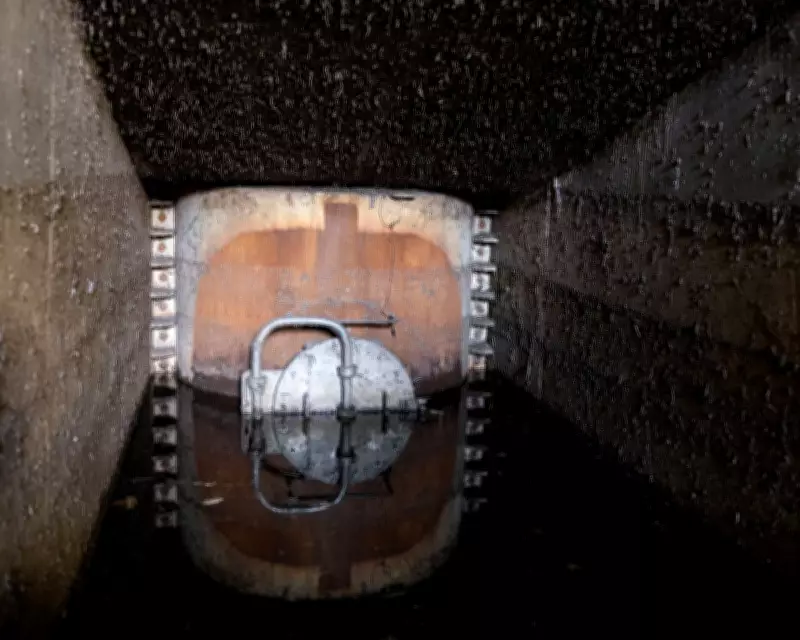
Sydney's Inaccessible Fatberg Plagues Malabar Wastewater Plant
A disturbing environmental issue has emerged at Sydney's Malabar wastewater treatment plant, where a massive fatberg—a congealed mass of fats, oils, and grease—remains trapped behind a sealed bulkhead door. Reporter Penry Buckley recently toured the facility, describing an "eerily odourless" pool of rainwater collecting in front of the door, masking the problematic accumulation within.
The fatberg, which cannot be accessed or cleared by plant staff, continues to deposit waste materials, including so-called "poo balls," onto Sydney's beaches, creating ongoing public health and environmental concerns. Buckley noted that while the area near the bulkhead door was surprisingly scent-free, other sections of the plant presented overwhelming odors.
"As we step inside, the smell matures quickly from a seaside pong to a meaty fug which opens up the nostrils," Buckley reported. "It's a pandemonium of aromas so bad they seem to cancel each other out." Remarkably, none of the plant staff wore any protective gear to cover their noses, with the hub manager commenting, "I reckon you're either built for sewage, or you're not."
London Coroner's Unsolved Mystery Case
In a separate story, American writer and journalist Patrick Radden Keefe has dedicated a year of investigation into the mysterious death of 19-year-old Zac Brettler, who jumped to his death in London. The coroner recorded an open verdict, openly admitting, "I don't know what happened." Keefe, known for his acclaimed work on Northern Ireland's Troubles, became intrigued by the case while filming in London and felt compelled to pursue the truth.
"This was that rare case where, within minutes, I knew that if this family was ready to talk, this would be how I'd spend the next year of my life," Keefe explained. His findings are now detailed in a new book, offering potential answers to this tragic and perplexing case.
Political Fallout for Netanyahu and Hawke's Legacy
International analysis suggests Israeli Prime Minister Benjamin Netanyahu may be emerging as the "biggest loser" in the ongoing conflict with Iran. Senior correspondent Peter Beaumont argues that Netanyahu's gamble has failed to achieve key objectives, including regime change in Tehran or seizure of uranium stockpiles, while further damaging Israel's global reputation amid accusations of genocide in Gaza.
Meanwhile, former Australian Attorney General Gareth Evans makes the case that Bob Hawke's government (1983-1991) represents a "gold standard" in political leadership. Evans cites six key factors, including high mutual respect among cabinet members and commitment to common causes, that fueled what he describes as "unparalleled reformist momentum" during Hawke's tenure.
The Booming Anti-Ageing Hand Care Industry
In a surprising consumer trend, the global hand care market is experiencing significant growth, driven by what some are calling the "facialisation of hand care." Aesthetic professionals argue that hands represent one of four "faces"—along with the actual face, neck, and chest—that should receive coordinated anti-ageing treatment to maintain visual harmony and authenticity.
"There's no point just working on one," explained one aesthetic doctor. "If it's not matching and there's no harmony, then we pick up on something else, which is a lack of authenticity. I liken it to a car. You wouldn't clean the front half of your car and leave the back half." The scientific basis for hand-focused anti-ageing concerns includes the thinner skin, fewer oil glands, and increased dryness susceptibility in hand tissue compared to facial skin.
While some express skepticism about this expanding beauty sector, brand founders promote hand-care rituals as both aesthetic enhancements and self-care practices, contributing to a market that shows no signs of slowing down.



