
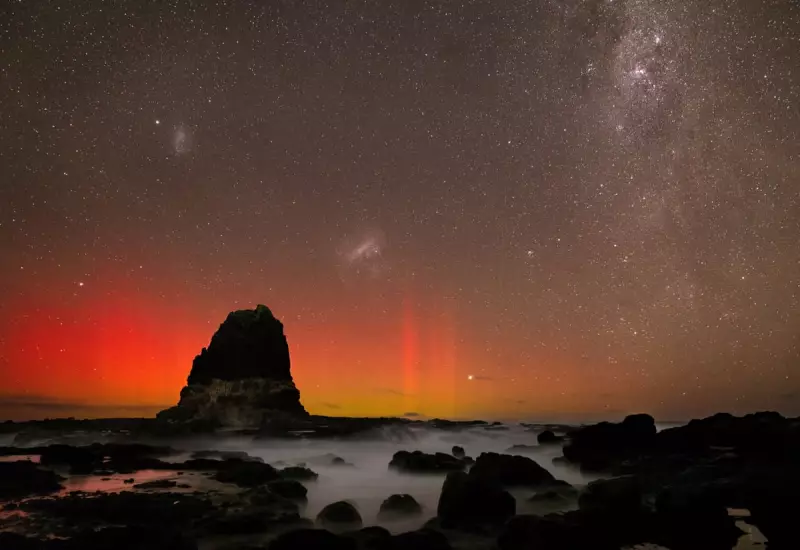
Skygazers across Australia are in for a rare celestial treat this Wednesday evening, as a powerful solar storm is set to make the spectacular southern lights visible across unusually northern locations, potentially including Sydney and Perth.
Where to Witness the Celestial Display
The Bureau of Meteorology's space weather forecasting centre has issued an aurora alert for mid to southern parts of Australia, with experts suggesting the display could reach further north than typically expected. Dr Laura Driessen, an astronomer from the Sydney Institute for Astronomy, confirmed that "Tasmania and New Zealand should get a decent view," while adding there's a genuine chance for residents in Sydney and Perth to witness the phenomenon.
Wednesday night represents the prime viewing opportunity according to astrophysicist Dr Sara Webb from Swinburne University, who notes the aurora will be "very high up the southern coast of Australia, so visible from parts of Victoria and New South Wales."
How to Maximise Your Aurora Viewing Experience
Experts recommend several strategies for those hoping to catch a glimpse of the southern lights:
- Head to dark locations away from city light pollution
- Look towards the southern horizon
- Allow your eyes to adjust to darkness for at least 15 minutes
Dr Webb advises that while the naked eye might only detect "a hint of it... maybe a little bit red or something fuzzy," modern smartphone cameras can capture far more detail. "Set your camera to take, say, a 10-second photo... your phone has collected more light than your eyes can process," she explains.
The Science Behind the Spectacle
The Bureau of Meteorology has confirmed that G4 geomagnetic storm conditions are currently being observed, just one level below the maximum G5 classification. "It is quite an intense geomagnetic storm, one of the largest that we've seen in recent years," notes Dr Webb.
This event coincides with the peak of the sun's 11-year activity cycle, which reached its maximum last October. During this period of heightened solar activity, the sun produces more sunspots and coronal mass ejections - massive bursts of solar plasma and magnetic energy.
Since 9th November, astronomers have observed two "massive" coronal mass ejections directed toward Earth, expected to arrive on Wednesday afternoon. When these highly charged particles interact with Earth's magnetic field, they energise atmospheric particles, particularly oxygen and neon, creating the spectacular coloured lights we recognise as auroras.
Potential Impacts Beyond the Light Show
While the visual display promises to be breathtaking, severe solar storms can have practical implications for modern technology. The highly charged particles can disrupt GPS systems and affect satellites orbiting Earth.
Dr Webb explains that satellite companies might need to put their equipment into "sleep mode - essentially, they shut them down so that there's less risk of damage." This precaution follows a 2022 incident where a solar storm caused dozens of Starlink satellites to burn up in Earth's atmosphere.
Historical precedents exist for more significant disruptions, including a 2003 event that caused a blackout in Sweden, disrupted northern hemisphere flights, and affected over half of all Earth-orbiting spacecraft. However, experts stress that such severe consequences are rare, and most modern infrastructure is designed to withstand these solar events.
For now, Australians should focus on the unique opportunity to witness one of nature's most spectacular light shows, with the aurora australis putting on a rare performance across much of the country.



