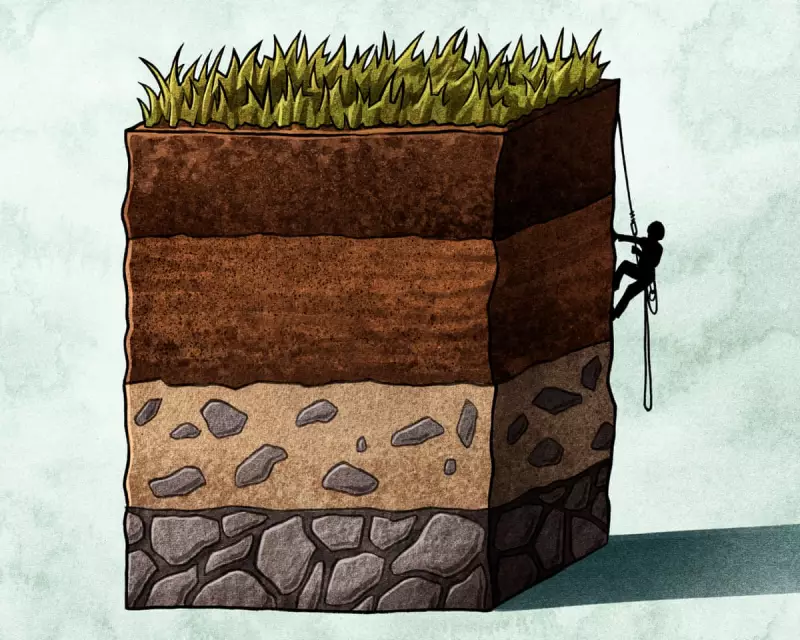
In a quiet Oxford pub, a conversation over a pint may have sparked a revolution in how we understand the very ground beneath our feet. Journalist and environmentalist George Monbiot, alongside a professor of geophysics, stumbled upon a radical idea: using the science of seismic waves to map and monitor soil health with unprecedented clarity.
The Frustrating Search for Farming's Holy Grail
For years, Monbiot had been grappling with a fundamental agricultural paradox. While researching his book Regenesis, he worked with pioneering farmer Iain 'Tolly' Tolhurst, who achieved something remarkable: high and rising crop yields with minimal environmental harm, using no fertilisers, pesticides, or animal manure. Tolly's methods appeared to 'train' soil microbes to release nutrients to crops when needed.
Yet, when other growers tried to replicate his techniques, results were mixed. Some succeeded brilliantly; others failed. The likely culprit was hidden variations in soil properties, but without the tools to see into this 'black box', no one could say for sure. Soil, which supplies 99% of our calories, remains one of the least understood ecosystems on Earth.
A Eureka Moment in The Magdalen Arms
The breakthrough came in February 2022 during a meeting with Professor Tarje Nissen-Meyer, then of the University of Oxford. Monbiot explained the problem: existing soil science was cumbersome, often requiring destructive digging and expensive, unscalable sampling. He asked if seismology—the study of waves through solid matter, heavily funded by the oil and gas industry—could be applied to soil.
Nissen-Meyer was intrigued. He confirmed that soil should be an excellent medium for seismic waves; in fact, seismologists usually treat soil vibration as 'noise' to be filtered out. That 'noise', they realised, could become the vital 'signal'. A follow-up literature search and a consultation with soil scientist Professor Simon Jeffery of Harper Adams University confirmed they were onto something novel and potentially transformative.
Birth of the Earth Rover Program
This conversation led to the creation of the non-profit Earth Rover Program, aiming to develop 'soilsmology'. The goal is threefold: to create open-source, cheap hardware and software for global use; to build a self-improving global soil database with farmers; and to fill a critical knowledge gap. The project received $4 million (£3m) in start-up funding from the Bezos Earth Fund and pro-bono legal support.
A major hurdle was cost. In 2022, suitable seismic sensors cost around $10,000 each. The team ingeniously repurposed equipment, finding a $100 geophone from a Slovakian experimental music outfit that worked perfectly. Scientist Jiayao Meng is now developing a sensor for roughly $10, with the future aim of using smartphone accelerometers, effectively reducing the cost to zero. Seismic waves are generated simply by hitting a metal plate with a welder's hammer.
Early Successes and Future Promise
The technology has already shown its worth. In its first deployment, the team measured a peat bog studied for 50 years. Within 45 minutes, they produced a preliminary estimate suggesting previous measurements were off by 20%. They could visually map the wavy boundary between peat and subsoil, rather than relying on extrapolation from point samples—a finding with huge implications for accurate carbon stock estimation.
The program has also successfully measured soil bulk density at a fine scale, tracked soil moisture, and begun developing the necessary AI and machine learning tools. Next steps include measuring connected porosity, soil texture, and soil carbon, and scaling up to hectare-level analysis.
With additional funding from the UBS Optimus Foundation and hubs on three continents, the ambition is vast. The team envisions a future where any farmer, anywhere, can get an almost instant readout of their soil's health. As more data is added to the global database, these readouts could translate into immediate, actionable advice, taking the guesswork out of sustainable farming.
This innovation could also revolutionise environmental policy. The EU's new soil-monitoring law, for instance, currently lacks practical implementation tools. The Earth Rover technology could provide a sensible, scientific way to verify farmers' contributions to soil health, moving beyond box-ticking on subsidy forms.
As farmer Roddy Hall, who is involved with the program, puts it, this could "take the guesswork out of farming." By making the invisible visible, seismology promises to shake up agriculture, helping the world reach that elusive goal: high yields with low environmental impact.