
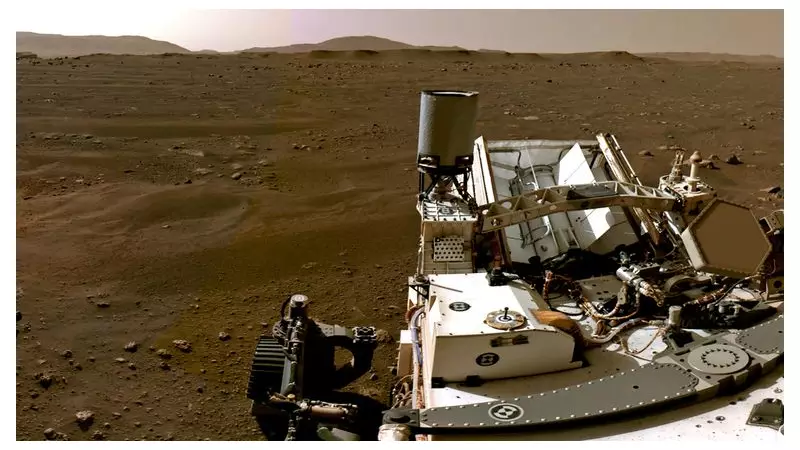
In a discovery that could reshape our understanding of the Red Planet, scientists believe they have detected lightning on Mars for the first time. The breakthrough came not from a specialised instrument, but from a microphone aboard NASA's Perseverance rover, which picked up the distinct crackle of electrical activity.
A Chance Discovery in the Martian Wind
A French-led research team announced the findings on Wednesday, 26 November 2025, after analysing data collected over just under four Earth years, equivalent to two Martian years. The researchers documented 55 distinct instances of what they are calling 'mini lightning'. These electrical arcs, mere inches in size, were detected within about six feet of the microphone mounted on the rover's tall mast.
Most of this activity was recorded during the planet's notorious dust storms. Scientists describe the sparks as being similar to static electricity discharges on Earth. Remarkably, the microphone was able to pick up the clear sound of these electrical bursts, even through the noise of powerful wind gusts and dust particles hitting the equipment.
Opening a New Field of Martian Science
The study's lead author, Baptiste Chide of the Institute for Research in Astrophysics and Planetology in Toulouse, expressed the significance of the find. He revealed that scientists have been searching for evidence of electrical activity and lightning on Mars for half a century. 'It opens a completely new field of investigation for Mars science,' Mr Chide stated. 'It's like finding a missing piece of the puzzle.'
The team analysed 28 hours of audio recordings from Perseverance, using both acoustic and electric signals to verify the presence of the possible lightning. This method of using sound to detect the phenomena was a novel approach for planetary science.
A Scientific Debate and Future Verification
Despite the compelling evidence, some in the scientific community are urging caution. The primary caveat is that the evidence comes from a single instrument, which was originally intended for studying rock composition, not atmospheric electricity. Furthermore, the electrical discharges were heard, but not visually observed.
Daniel Mitchard, Senior Lecturer in Lightning Physics and Engineering at Cardiff University, acknowledged the strength of the findings. 'It really is a chance discovery to hear something else going on nearby, and everything points to this being Martian lightning,' he said. However, he added that until new, dedicated instruments are sent to Mars to verify the findings, 'I think there will still be a debate from some scientists as to whether this really was lightning.'
Lightning has already been confirmed on other planets in our solar system, such as Jupiter and Saturn. The Perseverance rover, which has been exploring an ancient Martian river delta since 2021, continues its primary mission of gathering rock samples that might contain traces of long-extinct microscopic life. A planned mission to return these samples to Earth is currently paused as NASA seeks more affordable alternatives.



