
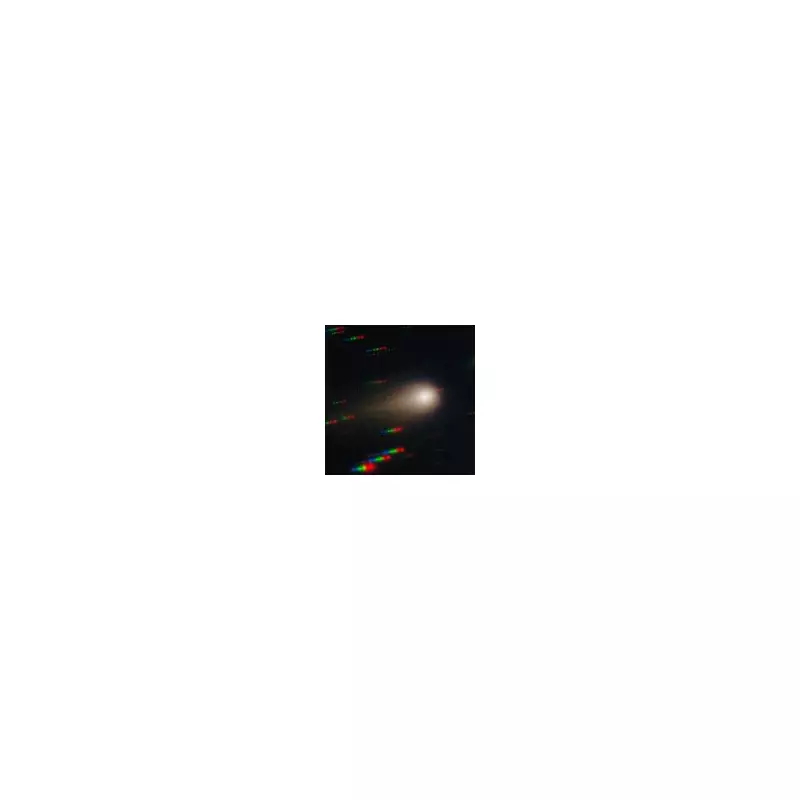
A dedicated search for alien technology on a mysterious interstellar visitor has come up empty, reigniting the debate over what constitutes proof of extraterrestrial life.
The Search for Technosignatures
In a significant development reported in January 2026, scientists from Oxford's Breakthrough Project have revealed the results of a targeted scan of the interstellar comet 3I/ATLAS. The team used the powerful Green Bank Telescope, one of the world's largest radio telescopes, to listen for any artificial signals emanating from the object.
The observations, which took place on December 18 when the comet was approximately 170 million miles from Earth, failed to detect any 'candidate signals' that would indicate the presence of technology. The findings were published in the Research Notes of the American Astronomical Society.
While signals were detected, none were the artificial technosignatures the team was seeking. The researchers concluded that 3I/ATLAS displays largely typical cometary features, including a coma and a non-elongated nucleus. They emphasised the need for more study of such objects, given that humanity has only observed three interstellar visitors so far.
Scientists Divided on the Meaning of Silence
The radio silence, however, is not the final word for everyone. Prominent Harvard astrophysicist Avi Loeb, a leading proponent of the theory that the comet could be an alien artefact, remains undeterred. Loeb had encouraged the Breakthrough Project to study 3I/ATLAS, which was discovered in July 2025 and made its closest pass by Earth in December.
Loeb pointed out to Metro that the comet originated from a region of space roughly aligned with the source of the famous 'Wow!' signal, an unexplained 72-second radio burst detected in 1977. He argued that the negative results are not conclusive.
'It is unclear whether a technological object would transmit radio signals to its senders because such signals would take tens of thousands of years to cross the Milky Way galaxy,' Loeb stated. He further noted that any signal might not have been directed at Earth, or transmitted on the frequency band monitored during the specific observation window.
UFO expert and filmmaker Mark Christopher Lee supported this view, telling Metro: 'This negative result only rules out certain types of transmissions... Advanced extraterrestrial intelligence, if it exists, might employ entirely different communication methods.'
The Case for a Natural Explanation
For other scientists, the latest data simply reinforces a natural explanation. Astrophysicist Dr Alfredo Carpineti, space correspondent for IFLScience, stated plainly that 3I/ATLAS is 'just that, a comet.'
'The "alien hypothesis" was never backed up by any data,' Carpineti said, 'but it is great to get telescopes to show, time and time again, that this interstellar interloper has nothing artificial going on.'
The comet, which was initially designated A11pI3Z, is now continuing its journey through our solar system. It is expected to make a gravitational pit-stop near Jupiter in the spring before heading back into interstellar space.
The debate underscores a fundamental principle in the search for extraterrestrial intelligence: absence of evidence is not evidence of absence. While the latest scan found no proof that 3I/ATLAS is an alien spacecraft, the quest to understand our place in the cosmos continues, with each new interstellar visitor offering a fresh opportunity for discovery.



