
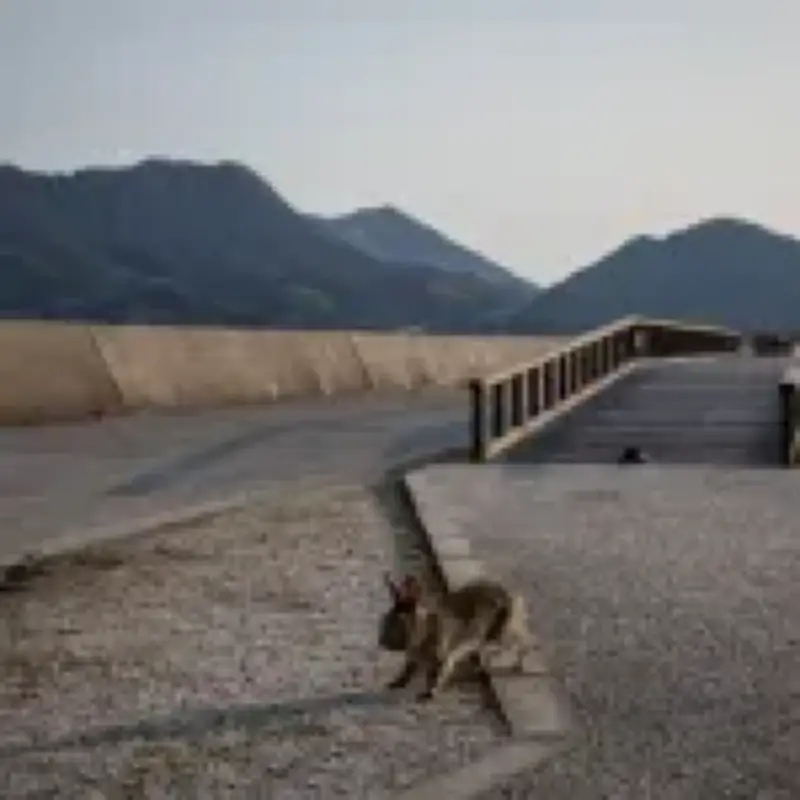
Okunoshima Island, known as Rabbit Island, is facing a new threat to its famous population of around 500 wild rabbits: wild boars have begun eating the rabbits' food, scavenging their carcasses, and in some cases, hunting live rabbits. The finding comes from a study published on July 29 in the Journal of Ecotourism, which highlights the unintended consequences of human handouts in reshaping the island's fragile ecosystem.
Wild boars preying on rabbits
The island, located about 60km east of Hiroshima city, has long been a popular destination for tourists eager to feed the rabbits up close. However, researchers found that the native wild boars have developed a taste for the rabbits, a behavior that surprised even the scientists. 'When we first heard that a wild boar had preyed on a live rabbit, we were surprised,' said Shingo Kaneko, a study co-author and ecologist at Fukushima University, in a statement. 'Wild boars are known to scavenge animal carcasses, but they are not generally regarded as animals that actively hunt live prey.'
The rabbits themselves are not native to Okunoshima. They are domestic European rabbits, introduced to the island after World War II, when the island was used as a testing ground for chemical weapons. From 1929 until August 1945, the island hosted poisonous gas research and production facilities run by the Japanese imperial army. The operation was so secret that Okunoshima was not included on maps of Japan from that time. Today, ruins of old military bases and chemical factories can be found across the island.
History of the rabbits
During the war, about 200 rabbits were used in experiments to test the efficacy of gas used by the Japanese military during the Sino-Japanese war and, later, to arm balloon bombs targeting the US. In the 1970s, a nearby primary school released rabbits back onto the abandoned island, and the population grew. In 2024, nearly 200,000 people visited Okunoshima, drawn mainly by the promise of experiencing a rabbit paradise. Now, there are so many rabbits that their numbers exceed what the natural ecosystem would otherwise support.
According to the researchers, 'food left by tourists may be attracting wild boars into the areas heavily populated by rabbits,' leading to more frequent encounters between the two species. The study's authors are clear that the new predators are not the main concern. Instead, they want to highlight how unchecked wildlife tourism can disrupt delicate environments.
Proposed solutions and global context
The solution, Shingo Kaneko and his team say, is stricter feeding regulations, rabbit monitoring, and vegetation analysis. They also believe a public awareness campaign could educate tourists and lead to greater safeguards.
The problem extends far beyond Rabbit Island. In Maya Bay and the Phi Phi Islands in Thailand, an influx of more than a million visitors each year has caused tour boats to crush coral reefs. Black-tipped sharks were driven from the idyll that was made famous as the set of Leonardo DiCaprio's 2000 thriller 'The Beach', until a tourism ban and the pandemic saw visitors vanish between 2018 and 2022. It's a similar story across the Galapagos, the Great Barrier Reef, and sub-Saharan Africa.
Then there's wildlife tourism in its ugliest form. According to animal rights groups such as PETA and the World Wildlife Fund (WWF), some of the most harmful experiences include riding or bathing elephants, swimming with dolphins, taking selfies with tigers, walking with lions, and posing for photos with primates or birds. Research from a 2016 World Animal Protection report found that three out of four wildlife tourist attractions involve some form of animal abuse or conservation concerns, and up to 550,000 wild animals are suffering in venues around the world.
Human risks and incidents
The practice puts humans at risk, too. Most recently, in January 2025, a Spanish tourist was killed by an elephant attack during a bathing experience at the Koh Yao Elephant Care Centre in southern Thailand. The elephant handler was charged with negligence causing death. Months later, in June 2025, an Indian tourist was mauled by a tiger at Tiger Kingdom in Phuket, Thailand, while attempting to take a selfie inside the animal's enclosure.
These incidents underscore the urgent need for stricter regulations and public awareness to protect both wildlife and tourists, as the study on Okunoshima suggests.



