
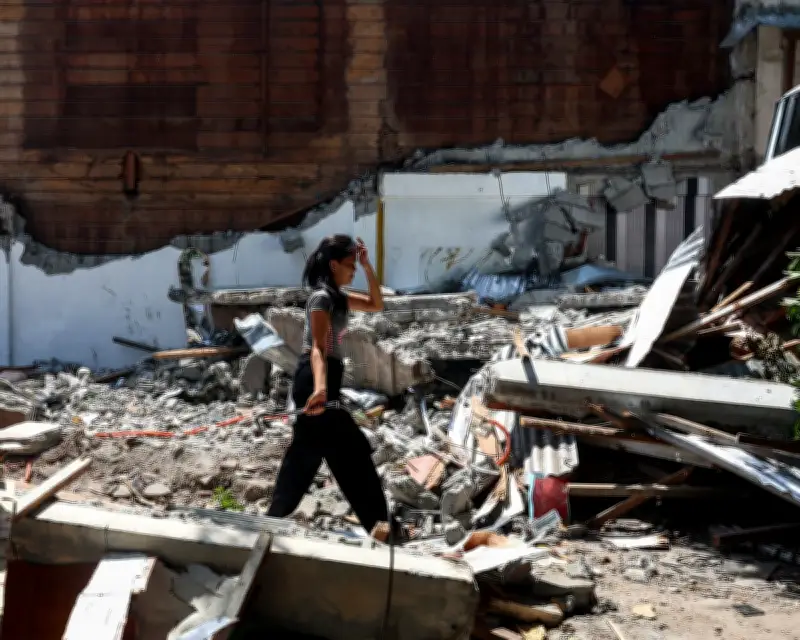
A young girl searches through the wreckage of her collapsed home in General Santos, Philippines, following a devastating earthquake on June 10, 2026. The 7.8-magnitude quake, the strongest to hit the nation in half a century, has killed at least 55 people and left a trail of destruction across the southern island of Mindanao.
Rescue Efforts and Human Toll
Rescue teams have been working tirelessly, pulling bodies from the debris. In one instance, a family wailed as the body of a loved one was recovered from a collapsed grocery store. "While tragic, it offered the family a painful consolation. They have a body to bury," said Rene Baliong, head of the search and rescue team. His team's spirits were lifted after they rescued a survivor alive on Tuesday. Dozens remain missing, and at least 1,120 people were injured. Over 45,000 have been displaced, many fleeing after a tsunami warning was issued.
Geological Context
The earthquake, triggered by movement in the Cotabato Trench, is the strongest since an 8.1-magnitude quake in 1976 that generated tsunami waves, according to Teresito Bacolcol, director of the Philippine Institute of Volcanology and Seismology.
Widespread Destruction
The quake caused a landslide that buried houses and killed 18 people in the mountainside town of Glan. In General Santos City, at least 13 died when buildings collapsed. At least 19 major commercial buildings, including a mall and hotel, were damaged, and more than 19,000 homes were affected.
Government Response
Authorities are providing food and water filtration systems after city pipes burst, said Rodrigo Sosmeña, regional director for civil defence. Rufa Cagoco Guiam, a university professor, noted the difficulty of buying essentials as major malls remain closed. "I'm going around the city now looking for a supermarket to buy food and water," she said.
Emotional and Mental Health Impact
The earthquake struck as students returned from summer break. "I think we underestimate the mental health toll, especially on children," said Drew Strobel from the International Federation of Red Cross. "People are really traumatised." Ten schools were damaged, and 6,000 remain closed for safety assessments. The Red Cross is providing mental health support, hot meals, and assessing livelihood impacts.
Recovery Challenges
The recovery could be complicated by weather: the predicted El Niño phenomenon, combined with the south-west monsoon, may bring both flooding and drought, Sosmeña warned. The region is a top rice producer, and coconut farming supports the economy in parts of Sarangani. "These are the main source of livelihood, and with abnormal weather and damaged infrastructure, we are bracing ourselves," he said. "Picking up the pieces after the earthquake is not an easy job."



