
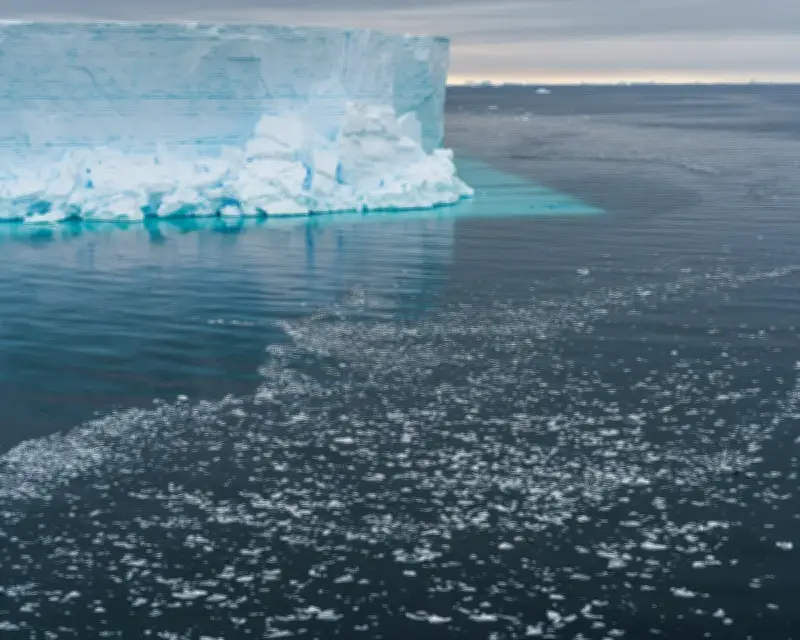
The Bellingshausen Sea, covering 650,000 square kilometers of sea ice compared to the 1991–2010 average, is a critical area. As winter grips Antarctica, sea ice typically expands rapidly around the continent, peaking in September. However, satellite observations reveal that the Bellingshausen Sea on the west side of the Antarctic Peninsula, which should be ice-covered by June, is nearly ice-free.
Unprecedented Ice Loss
Scientists report that the region is missing approximately 650,000 square kilometers (250,000 square miles) of sea ice relative to the 1991–2020 average—an area comparable to France and nearly ten times the size of Tasmania. Dr. Will Hobbs, an Antarctic sea ice expert at the University of Tasmania and the Australian Antarctic Program Partnership, expressed deep concern. "I'm concerned. It's depressing," he said. "It is remarkable that we are in June and there is no sea ice there." He noted that this marks the third time in four years that sea ice has been critically low in the region, adding, "I don't think we will see sea ice there any more. It's done."
Oceanic and Climatic Links
Dr. Hobbs emphasized that the ice loss is likely tied to ocean changes, and scientists are investigating whether global heating plays a role. The region is vital for krill, a cornerstone of the food web, which typically hides under ice in winter to graze on algae. On June 10, total Antarctic sea ice extent was about 11.4 million square kilometers, below the long-term average of 12.6 million square kilometers for that date.
Dr. Phil Reid, who monitors Antarctic conditions at Australia's Bureau of Meteorology, highlighted that the Bellingshausen Sea has experienced "incredible coastal exposure" in both winter and summer recently. To the west lie the Pine Island and Thwaites glaciers, major contributors to ice loss and sea level rise. Floating ice shelves in front of these glaciers could disintegrate faster if protective sea ice is absent for extended periods, potentially accelerating glacier ice loss and elevating global sea levels.
Impact on Wildlife
The Bellingshausen Sea coastline witnessed tragedy in late 2022 when thousands of emperor penguin chicks died in a "catastrophic breeding failure" across four colonies. This event contributed to the species being reclassified as "endangered" by UN advisers earlier this year. Dr. Peter Fretwell of the British Antarctic Survey, who has documented penguin declines, stated that the current ice loss is "a serious problem for penguins, especially emperors. Sea ice is forming too late and breaking up too early. It leads to reduced breeding success and longer trips to moulting grounds." Adelie penguin numbers are also falling, and crabeater seals are migrating in summer to find stable ice.
Heatwave Exacerbated by Ice Loss
This month, the Antarctic Peninsula experienced an extreme temperature spike over several days. Dr. Hobbs noted that while "nobody has done the numbers," it is reasonable to suggest the heatwave was "made worse by the lack of sea ice," as sea ice typically cools incoming warmer air from the north. Officials at Argentina's National Weather Service reported an "extreme temperature event" at the Esperanza base on the peninsula's northeastern tip, peaking on June 5 and 6 with maximum temperatures of 15.4°C and 13.4°C, respectively, compared to average daily maximums of -6.2°C. The previous June record of 13.3°C was set on June 12, 1998.



