
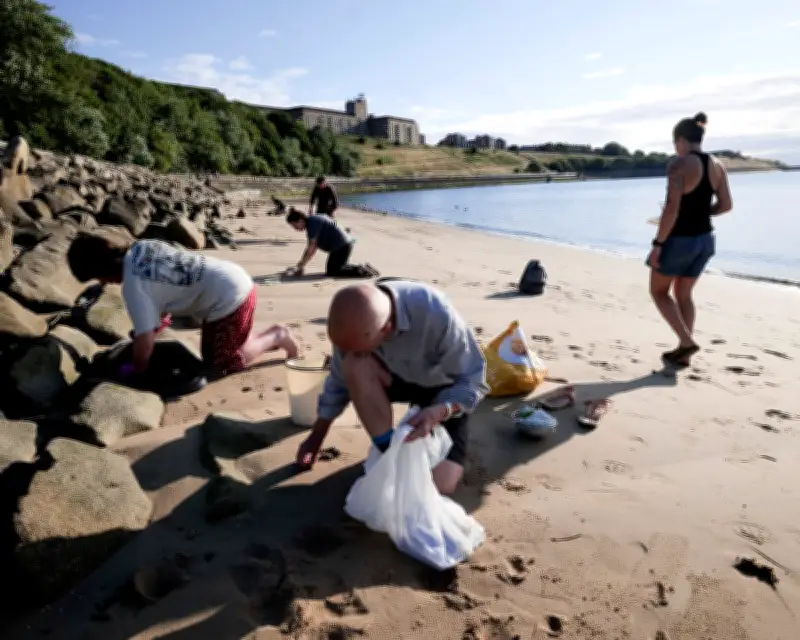
Up to 2,000 volunteers have been mobilising on beaches from Cambois in Northumberland to Seaburn on Wearside, painstakingly sifting sand to remove billions of tiny plastic pellets after a ship collision on 19 July at the Port of Tyne, South Shields. The spillage, estimated at up to 25 tonnes, has prompted an unprecedented community response, with volunteers using dustpans, brushes, buckets, and kitchen sieves to collect the lentil-sized nurdles.
Community-led cleanup effort
Alice Laverty, a Whitley Bay bookshop owner and one of the first responders, described the scene: “You’ve got a local community that really cares about the coastline. They’ve all got a dustpan, a brush, a bucket, a kitchen sieve.” She added, “I saw the horrendous pictures of millions of them floating down the Tyne and I went to the beach in the evening. I was literally the only person on the beach with a dustpan and brush and I could see people looking at me going … what is she doing?”
Since the collision, nurdles have washed up on numerous beaches, sometimes forming thick drifts that visibly scar the landscape. Volunteers have been drawing squares and cleaning the beach section by section, racing against the tides. Laverty noted, “It becomes quite addictive. I can’t walk past a nurdle without picking it up, and I reckon most Whitley Bay residents will be exactly the same.”
Official response and volunteer coordination
The spillage has sparked anger and protests, with north-east mayor Kim McGuinness vowing to ensure shipowners contribute to what she called a “pollution emergency”. The Port of Tyne, HM Coastguard, the Environment Agency, local councils, and specialist contractors are all involved in what has been described as “a coordinated multi-agency effort”. However, volunteers say an official response with specialist equipment takes time, and concerns about insurance and liability could delay operations.
Laverty emphasized the urgency: “There’s no nurdle fairy, this needs to be cleaned up now. An official response with specialist equipment and trained staff takes time, and concerns about insurance and liability could further delay cleanup operations.” By Sunday, about 3,000 volunteer hours had been logged, and an estimated 285kg of nurdles had been recovered by the “people’s army”. An open letter is due to be sent on Monday calling for trained local teams to be allowed to help clear nurdles directly from the rivers, not just the beaches.
Volunteer motivations and fears
Helen Charlton, a business academic from Cramlington, said: “This is our home. I’m north-east born and bred and I’m incredibly proud of this region and I’m incredibly proud of the industry and commerce here as well. It’s not that we shouldn’t have shipping on the Tyne because we absolutely should. But the two have to coexist.”
Lou Shackleton, a life and work coach from Whitley Bay, highlighted the broader dangers: “Everything is interconnected. The people that are fishing need the fish to be there and healthy. The seals need the fish. I heard a boat broke down yesterday because of nurdles affecting the engine. It’s the summer holidays, there’ll be people in the sea, kids playing. I have a five-year-old, I don’t want him to be still finding nurdles on the beach in 10 years’ time.”
Innovative tools and environmental impact
Amy Ash, a user experience designer, has created a web app to help organise and mobilise the volunteers. “I surf, I swim, I’ve got two kids,” she said. “It is absolutely devastating that these things are on the beach. I really do not want this to be forgotten about.” In addition to sweepers and sifters, dozens of volunteers have been sewing mesh bags for collecting nurdles using scaffolding fabric.
Nurdles are tiny disc-shaped plastic pellets that serve as the raw material for most plastic products. Animals can easily mistake them for food with deadly consequences, campaigners warn. The environmental charity Fidra, which works to end plastic and chemical pollution, says nurdles are a global problem. Last year it found plastic nurdles at 84% of the UK’s sites of special scientific interest.



