
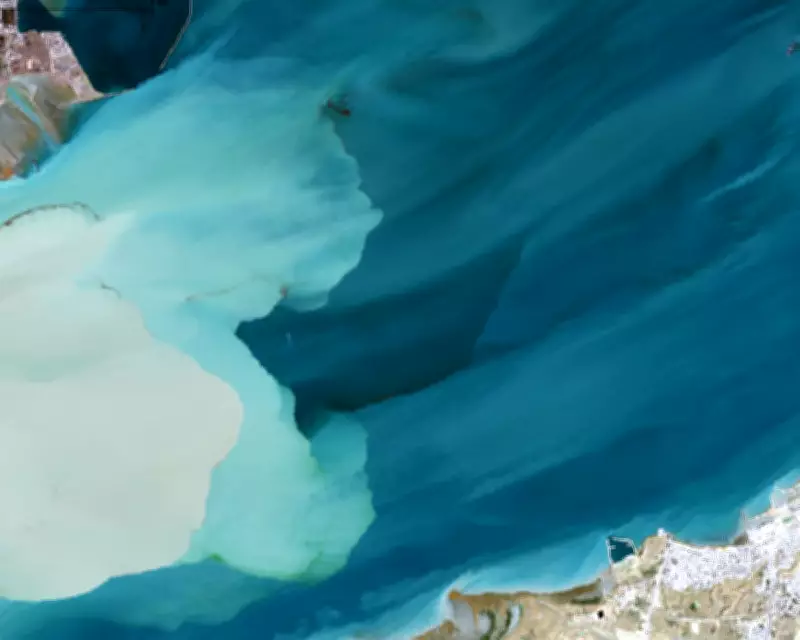
Satellite Imagery Captures Iranian Vessel Oil Spill Menacing Protected Wetland
Satellite image analysis has revealed a significant oil slick emanating from the wrecked Iranian drone carrier Shahid Bagheri, now posing a direct contamination threat to one of West Asia's most vital wetland ecosystems. The vessel, struck by a U.S. warplane in early March during the U.S.-Israel offensive against Iran, has been leaking heavy fuel oil in Iranian territorial waters near the Strait of Hormuz for approximately one month.
With Iran enduring continuous bombardment, cleanup operations have been impossible to initiate, allowing the oil to migrate slowly westward. Its trajectory is alarmingly directed toward the Hara Biosphere Reserve, the largest mangrove forest along the Gulf shoreline, which serves as a critical habitat for numerous species.
Ecological Significance of the Hara Mangrove Forest
The Hara mangrove forest is an indispensable ecosystem supporting migrating birds, critically endangered turtles, and diverse populations of fish and crustaceans. Coastal fishing communities in the region rely almost entirely on these marine resources for their livelihoods, making the potential contamination a severe socio-economic as well as environmental crisis.
Tim Richards, a retired satellite remote sensing consultant monitoring the spill, reported that by March 18, the oil had traveled 16 miles southwest toward Hara. He cautioned that this spill could represent the most ecologically damaging event in the region since the first Gulf War, highlighting the grave implications for biodiversity and local economies.
Details of the Shahid Bagheri and the Spill Dynamics
The Shahid Bagheri, described as one of the most conceptually significant vessels in Iran's navy, is a modified container ship equipped with a short runway for drone launches. Its substantial fuel capacity, with the IRGC claiming a range of 22,000 nautical miles and annual refueling intervals, suggests a potentially large volume of oil leakage.
After being bombed by U.S. warplanes on March 6, the vessel has remained grounded in shallow waters within the central Khuran strait, a narrow and ecologically sensitive channel between the Iranian mainland and Qeshm Island. Circular currents in the strait have contributed to the oil's slow westward movement, influenced by water inflow from the Indian Ocean and tidal patterns.
Richards noted that rainfall on March 27 appeared to wash sediment into the strait, mixing with the oil. By March 28, the spill had advanced an additional 20 kilometers, with potential for further dispersion due to increased water flow through the Bandar-e Pol area and the rainfall event.
Broader Context of Gulf Environmental Incidents
This spill is not an isolated incident but part of a series of environmental hazards arising from the conflict. The U.S. sinking of multiple Iranian ships at the war's outset and Iran's attacks on container ships and oil tankers enforcing its Strait of Hormuz blockade have compounded risks.
Wim Zwijnenburg, an environmental analyst compiling a database of war-related harmful incidents, has documented additional small spills off the coasts of Iraq and Kuwait, another in the Strait of Hormuz from a sunken container ship, and a spill from the U.S. torpedo attack on the Iranian navy ship Dena near Sri Lanka, which Sri Lankan authorities addressed.
Zwijnenburg warned of escalating dangers, stating, "If you keep shooting at oil and chemical tankers, at some point you will create a catastrophe if it goes wrong. So generally it's a bad idea to fire missiles and drones at oil ships and chemical tankers. I think, so far, the environment has been escaping a disaster from all these attacks."
The ongoing conflict continues to threaten marine ecosystems and coastal communities, with the Shahid Bagheri spill underscoring the urgent need for environmental protection amidst warfare.



