
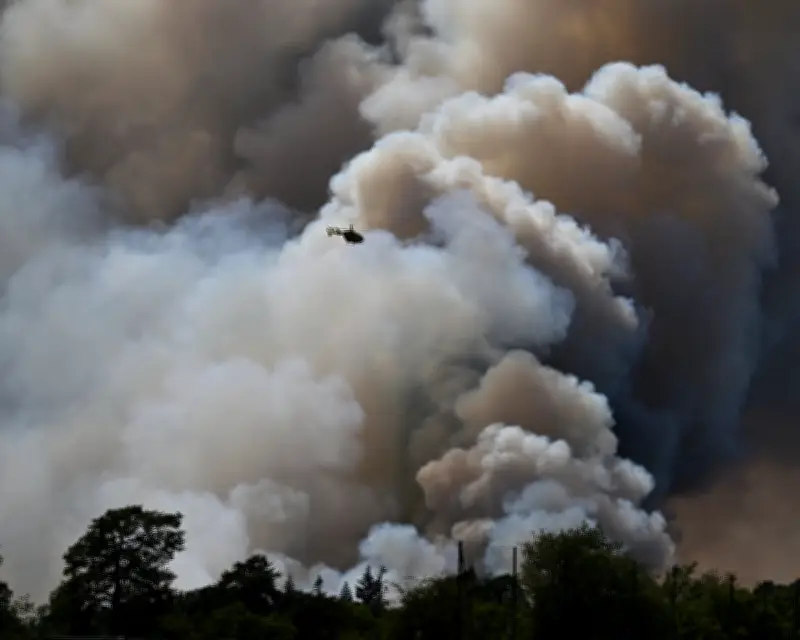
A new and ominous term has entered the vocabulary of firefighters battling the vast wildfire sweeping through southwest France: pyrocumulonimbus. This fire-generated thunderstorm can whip up winds unpredictably, making containment and course assessment far more difficult. Known in North America and Australia, firefighters believe France is experiencing its first such event in the Bordeaux region as the country endures its third major heatwave of the summer and prepares for a fourth.
Dire statistics reveal deepening devastation
The ongoing fires in France and Spain tell a story of deepening misery. A far greater expanse of French land has already burned this year compared with the 30,000 hectares during all of 2025, while 220,000 people have been evacuated from their homes in the Gironde. In Spain, the environment ministry reports over 170,000 hectares affected, versus 29,000 last year, with more than 100,000 people forced to flee.
Climate scientists' warnings become reality
As climate scientists long warned, Europe's wildfires are worsening in intensity, scale, and duration as the planet heats up. Spanish Prime Minister Pedro Sánchez attributed the crisis to the climate emergency, stating the obvious. However, he has been among the few leaders arguing that the EU's green transition should be accelerated accordingly. Whether on funding adaptation or driving macro changes to slow global heating, too many others appear happy to fiddle while the continent burns.
Political backtracking on green policies
In June, Emmanuel Macron's government sought savings by announcing steep cuts to a Green Fund designed to help local authorities address climate and environmental challenges. Across Europe, amid low growth and fallout from Donald Trump's war on Iran, a false dichotomy is increasingly drawn between green ambition and competitiveness. This month, under pressure from countries like Giorgia Meloni's Italy, the European Commission proposed weakening the EU's emissions trading system. If adopted, heavy industry would receive free polluting permits for longer and at lower cost.
The false pragmatism argument
Calls for diluting green measures are often accompanied by assertions that Europe needs a more pragmatic approach amid geopolitical uncertainty and economic competition. This argument is wrong twice over: the faster the EU moves toward net zero, the better it consolidates Europe's position in future global markets. More fundamentally, as this summer's wildfires vividly illustrate, the notion that climate measures are optional add-ons appropriate only in good times is wildly at odds with developing reality.
Heatwaves accelerate, policy lags
As a fourth heatwave hits Europe, temperatures in southwest France are predicted to reach 40C on Wednesday. According to a recent study, if the warming rate of the last decade continues, the 1.5C limit set by the Paris agreement will be redundant by 2030. Yet far from catching up with the pace of change, too many governments are putting their foot on the policy brake. That is not realism; it is a dereliction of duty.



