
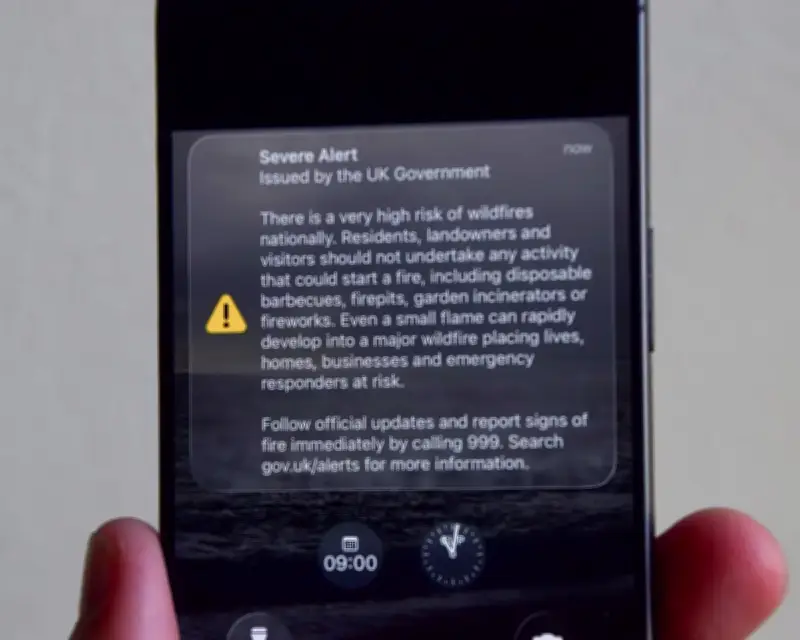
Readers have expressed alarm over the government's emergency alert on wildfires, which sounded on phones across the UK on Friday evening. In letters to the Guardian, they argue that the loud, sudden notification could cause accidents, especially for drivers, and question whether the alert's content—advising against disposable barbecues—warrants such a disruptive approach.
Drivers describe terrifying moments
Elspeth Christie from Kirkhaugh, Northumberland, recounted a frightening experience while driving with two passengers. She was reversing into a tight parking space, inches from other cars, when a terrifyingly loud noise erupted from her passengers' phones and presumably her own. "I thought someone on the road was trying to warn me of something immediately dangerous, and looked around desperately trying to see if I'd killed someone," she wrote. "If I'd been travelling at speed, this could have caused a bad accident."
Christie questioned the necessity of such an intrusive alert for a message about disposable barbecues. "And all to tell us not to buy disposable barbecues? How much of an emergency is that?" she asked, suggesting that genuine alerts should be delivered in a way that does not put people at risk, and that less urgent information, like changes in the law, could be communicated more gently.
Criticism of government response to extreme heat
Another reader, Alan Murphy from London, criticized the government's overall reaction to the extreme heat, which included a belated Cobra meeting and a ban on portable barbecues. He wrote, "So, the outcome of the belated Cobra meeting in reaction to the extreme heat is a ban on portable barbecues and an emergency alert telling us what we already know." Murphy offered a satirical headline: "Burnham fiddles while Britain burns."
The letters reflect broader concerns about the effectiveness and safety of emergency alert systems, which are designed to warn the public of imminent threats but may inadvertently create new risks. The government has defended the alert as a necessary tool for public safety, but these firsthand accounts highlight potential unintended consequences.
Impact and next steps
As the UK continues to experience more frequent extreme weather events due to climate change, the debate over how to communicate emergency warnings is likely to intensify. The government may need to consider alternative methods that balance urgency with safety, ensuring that alerts do not endanger the very people they are meant to protect.



