
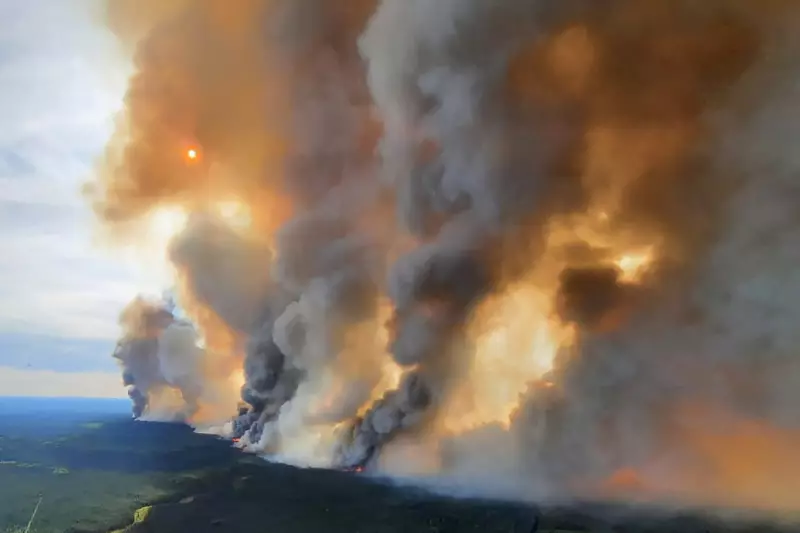
The Unquenchable Blaze: When Wildfires Refuse to Die
In May 2023, a single lightning strike ignited the dry forests of Donnie Creek in British Columbia, sparking what would become one of the most formidable wildfires in the province's recorded history. An unusually dry autumn followed by a warm spring had transformed the vast boreal landscape into a tinderbox, allowing flames to spread with alarming speed. By mid-June, the inferno had consumed an area nearly twice the size of central London, contributing to a record-breaking year where more of Canada burned than ever before.
The Rise of the Zombie Fires
When winter's cold traditionally signals the end of wildfire season, the Donnie Creek fire defied expectations. Instead of extinguishing, it continued to smoulder beneath the snowpack, insulated from freezing temperatures by the thick organic soils. The following spring, it reemerged as what scientists term a 'zombie fire' – a blaze that survives winter underground only to reignite when conditions allow. This particular fire continued burning until August 2024, ultimately destroying over 600,000 hectares (1.5 million acres) of precious forest.
Professor Lori Daniels from the University of British Columbia explains the severity: 'It is a massive problem. Zombie fires, also called holdover fires, are fires that move into the organic soil matter and smoulder. It's a very slow, but hot, combustion through a prolonged period and then they resurface.' The scale became apparent when over 100 fires were still burning in December 2023, continuing into spring 2024.
Environmental Impact and Climate Feedback Loops
The consequences of these persistent fires extend far beyond immediate forest destruction. The northern hemisphere's permafrost regions, covering approximately 15% of the land area, contain roughly twice as much carbon as currently exists in the atmosphere. When these organic soils burn slowly at lower temperatures, they release significantly more particulate pollution and greenhouse gases than typical flaming fires.
'These boggy soils take hundreds to thousands of years to accumulate the carbon that is stored in the organic soil layers,' Professor Daniels emphasises. 'In some cases, it's burning right down to the rock. Over a very short period of time, we are combusting all of this ancient carbon into the atmosphere.' This process creates a dangerous climate feedback loop where burning permafrost releases more carbon, accelerating global warming and creating conditions for more fires.
The ecological damage is profound. Normal, low-intensity fires typically allow forests to regenerate quickly as they leave seed-rich soils intact. However, zombie fires burn with such intensity and duration that they destroy the seed bank, leaving behind only mineral soils of sand, clay and silt where regeneration becomes exceptionally difficult.
Compounding Crises and Future Projections
The problem appears to be accelerating. By mid-September 2025, Canada had already seen 8.8 million hectares (21 million acres) burn across hundreds of fires. Researchers believe many early season blazes were likely zombie fires that had overwintered from previous years.
Professor Patrick Louchouarn from Ohio State University warns: 'This has the potential to become really problematic. The more of the permafrost dries out and some of those organic, rich soils dry out in the Arctic, and the more you increase the temperature, there's greater possibility for that fuel to be ready to burn.'
Northern communities are already experiencing the traumatic consequences. Professor Jennifer Baltzer recounts the 2023 Northwest Territories crisis: 'Seventy percent of the region was evacuated and it was very traumatic. People were driving through crazy fires to get away from their homes. There were lots of these overwintering fires around communities that had to be evacuated.' The psychological impact is significant, as winter traditionally provided a safe respite from fire threats that no longer exists.
Scientists are urgently developing satellite detection methods to identify these elusive holdover fires, while fire crews now face year-round containment challenges. Similar patterns are suspected in Siberia, though research collaboration difficulties with Russian scientists have limited comprehensive study.



