
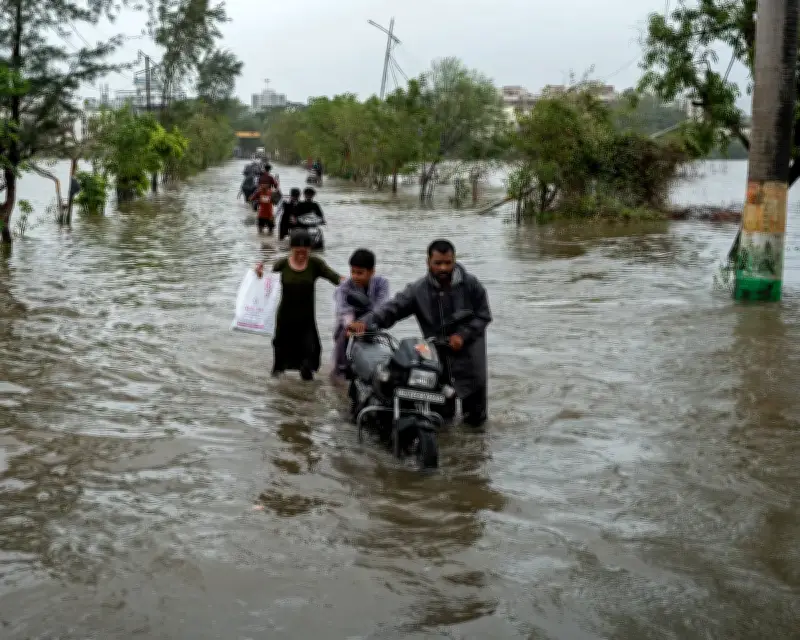
The United Nations Environment Programme (UNEP) has released a report warning that global heating will reach at least 1.8C above pre-industrial levels, even under the most optimistic future scenarios. This projection significantly exceeds the Paris agreement's goal of limiting warming to 1.5C. The report, based in Nairobi, emphasizes that every fraction of temperature rise intensifies destructive extreme weather, ecosystem loss, and the submersion of islands and coastal cities.
No Good Outcomes Above 1.5C
The UNEP report states that "there are no good outcomes above 1.5C," highlighting that human health, water supplies, nature, cities, infrastructure, and economies could all be severely damaged. Some losses would be irreversible, and many communities may have to relocate due to the impacts of climate change.
However, scientists note that the world could potentially return to 1.5C through deep, rapid emissions cuts and the removal of carbon from the atmosphere. This includes establishing vast new forests, which should complement, not replace, deep cuts in fossil fuel pollution.
Nepal Flood Victims Identification
In Nepal, authorities are urging relatives of the thousands of missing and dead from recent flash flooding to provide blood samples for DNA testing. At the Nepal Police hospital in Kathmandu, grieving families are lining up to provide DNA samples in hopes of identifying victims. Guardian Australia's Cait Kelly, reporting from Nepal, has documented harrowing accounts of those searching for missing loved ones, including survivors who lost their parents.
Australian Treasurer on Social Media Algorithms
Australian Treasurer Jim Chalmers has stated that social media algorithms are one of the biggest challenges facing society today. He criticized the business model of big platforms that seek to polarize users, saying, "If you made a short list of the biggest problems that we’ve got in our society, I think the role of social media would be on that list." Chalmers added that "our society, our social cohesion, the way that we come at big problems, including in my part of the shop, in the economy, is hampered, not helped, by the way that algorithms are dominating people’s day."
Shark Drone Surveillance in Sydney
Following a shark attack on Sydney teacher and mother Leah Stewart in June, drone surveillance has been expanded at ocean beaches. Under a $34m initiative by the state government, 38 of Sydney's ocean beaches, including Coogee, now receive dawn-to-dusk drone monitoring year-round. Previously, drone surveillance was not permitted at Coogee beach due to its location under the flight path from Sydney airport's east-west runway. The initiative aims to enhance beach safety and prevent future shark attacks.



