
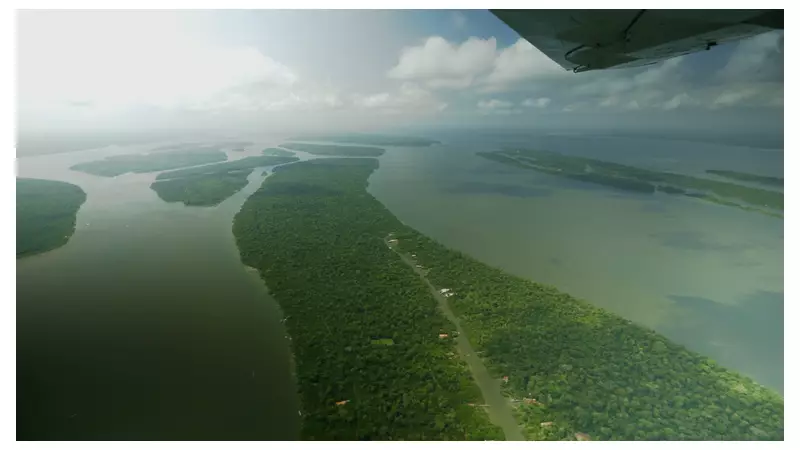
Senior Brazilian officials have expressed their surprise and disappointment after the United Kingdom decided not to contribute to a groundbreaking new fund designed to protect the world's tropical rainforests, despite having played a key role in its creation.
A Surprising Snub from a Key Ally
The revelation came as Brazil uses its position as host of the upcoming COP30 climate talks to promote the Tropical Forests Forever Facility (TFFF). The Amazon nation developed the scheme with input from several countries, including the UK and Indonesia.
According to a source who spoke to Sky News, the Brazilians were 'livid' about the timing of the UK's decision, which emerged the day before the fund's official launch. The news broke during Prime Minister Sir Keir Starmer's visit to the Amazonian city of Belem, with the UK government citing its imminent budget day as the reason for holding back immediate investment.
Garo Batmanian, the director-general of the Brazilian Forestry Service and the scheme's coordinator, stated, 'We were expecting [Britain to pay in] because the UK was the very first one to support us.' He noted that the TFFF was drawn up with the help of 'very bright people from the UK' and expressed hope that Britain would reconsider once its internal financial situation stabilises.
Flipping the Economics of Forest Conservation
The TFFF has been hailed as a potential breakthrough in the long-standing challenge of protecting rainforests. For decades, forests have been worth more financially when cleared for timber, agriculture, or mining. This new fund aims to fundamentally change that dynamic by making forests more valuable when left standing.
The fund would pay countries and communities for every hectare of standing forest they maintain, moving beyond a narrow focus on carbon credits. Another key innovation is its structure; rather than relying on traditional aid donations, the TFFF is designed as an investment fund that must compete commercially.
Paul Polman, former Unilever CEO, endorsed the plan, stating, 'This isn't charity, it's smart economic infrastructure to protect the Amazon and keep our planet safe.' The proposal earmarks at least 20% of all payments for indigenous communities, who are widely recognised as the most effective stewards of these vital ecosystems.
Funding the Future of Our Forests
To get off the ground, the ambitious plan requires a significant initial investment. The strategy involves raising a first tranche of capital from governments, which is intended to de-risk the fund and attract private investors. The goal is that every $1 of government money could leverage an additional $4 from the private sector.
So far, the TFFF has secured $5.5 billion in commitments from nations including Norway, France, and Indonesia. The World Bank has also agreed to host the fund, lending it considerable credibility. However, Brazil estimates it needs between $10 and $25 billion in government funding to launch effectively and generate the competitive returns needed to outperform lucrative but destructive industries like gold mining and oil extraction.
Dr Andreza Aruska de Souza Santos of King's College London's Brazil Institute noted that while the TFFF has the potential to make forest conservation financially viable, it faces a significant challenge. 'The problem is that TFFF would need to compete with these very profitable industries,' she said.
The UK's climate envoy, Rachel Kyte, sought to reassure partners, telling Sky News that the Prime Minister's decision was about timing. 'The PM agreed the decision was about not doing it now, as opposed to not ever,' she said, adding that the UK would review the TFFF after its budget is announced.



