
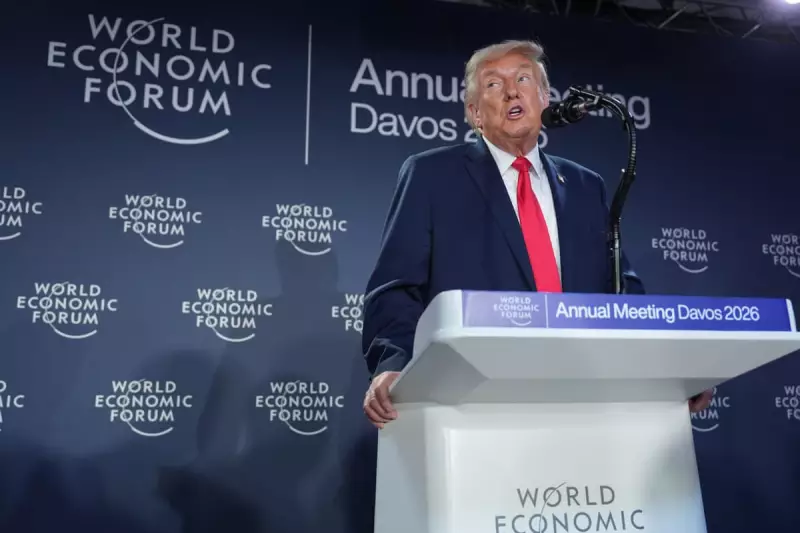
In a striking address at the World Economic Forum in Davos, Switzerland, former US President Donald Trump labelled clean energy initiatives as the 'green new scam', setting the stage for a significant geopolitical shift. This rhetoric preceded the United States' official departure from the Paris climate agreement for a second time, a move that solidifies Trump's renewed break from the primary international framework designed to combat global heating.
US Stands Alone in Climate Retreat
The withdrawal, first announced on Trump's inaugural day back in office last January, leaves the United States as the sole nation to have exited the Paris pact. This places America alongside Iran, Libya, and Yemen as the only countries not participating in the agreement. While global climate efforts will continue, experts caution that this development could significantly hinder progress and complicate diplomatic relations.
Basav Sen, climate justice project director at the Institute for Policy Studies, commented on the administration's stance, stating, "It's almost like they're saying, we don't care what you want from us, we will be the bad guys, and you cannot challenge us on it." This sentiment underscores a broader assault on domestic climate policy, including plans to leave the UN framework convention on climate change.
Global Climate Efforts Persist Amid US Withdrawal
Despite the US retreat, investment in low-carbon energy continues to outpace fossil fuel spending globally. Renewable sources accounted for over 90% of new power generation capacity last year, becoming the cheapest source of new electricity in many regions. China, in particular, is shaping the green transition, with its emissions appearing to have peaked and its firms dominating clean energy supply chains, producing more than 80% of the world's solar panels.
Sue Biniaz, a former deputy climate envoy under President Joe Biden, highlighted the risks, noting, "Yes, the real economy is moving towards renewables, but there's still a role for the global regime in sending political signals. Now, that ambition is going to fall behind." She warned that other countries might use the US's lack of climate ambition to justify their own reduced efforts.
Potential Ripple Effects and International Responses
The US disengagement could have far-reaching consequences. Jeremy Wallace, a professor of China studies at Johns Hopkins University, suggested that "the US abdication on climate allows fossil advocates in China more voice to slow down the energy transition." Conversely, some nations, such as Colombia and the Netherlands, are reportedly taking bolder climate actions in response, with plans to host talks focused on phasing out fossil fuels.
However, any increase in emissions driven by Trump's fossil fuel expansion will impact global targets, making it harder for ambitious countries to meet Paris goals. Sen added, "If the domestic market in the US continues to be dominated by fossil fuels, that will have an impact on the rest of the world," especially as energy demand from AI data centers rises.
Credibility and Climate Finance at Stake
The withdrawal also removes the US, the world's richest nation, from efforts to assist poorer countries in transitioning away from fossil fuels, pushing climate finance goals further out of reach. Wallace remarked, "I'm not sure if the United States has any credibility left to lose, but withdrawing from Paris for a second time does not help."
As the planet experiences record heat and worsening climate-related disasters, Biniaz emphasised the timing, stating, "Every scientific report tells us things are worse than we thought. It's the wrong time to be pulling out of the key agreement dealing with the issue." This move reinforces perceptions of the US as an unreliable partner in global policy, potentially stalling momentum in the fight against climate change.



