
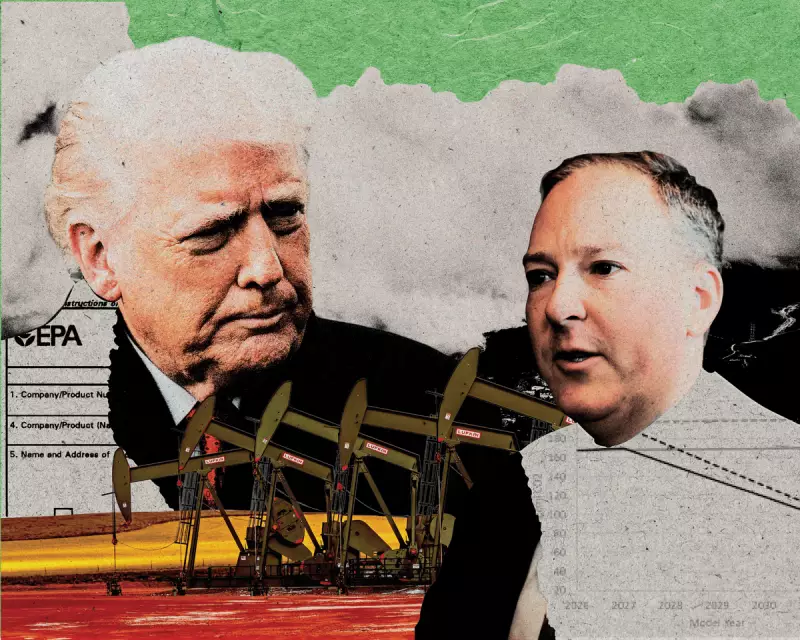
EPA Under Trump Accused of 'Shameful' Shift from Public Health to Business Priorities
One year into Donald Trump's second presidential term, the Environmental Protection Agency stands accused by numerous critics of effectively abandoning its fundamental mission to safeguard public health and the environment. Observers claim the agency has undergone a radical transformation, systematically rolling back environmental protections while actively championing industries historically at odds with regulatory oversight.
Fundamental Mission Reversal
William Reilly, who served as EPA administrator under Republican President George H.W. Bush, expressed profound concern about the agency's current direction. "The EPA was designed to protect public health and the environment and did a remarkably effective job of that," Reilly stated. "That record is now at risk and we will see the degradation of air quality in major cities. The administration seems to conceive the purpose of the agency as solely promoting business, which has never been the agency's mission. That's revolutionary – it's not been seen before."
Reilly highlighted a particularly startling example from last year when the EPA invited businesses to simply email requests for exemptions from air pollution regulations. "The notion you could be excused from a black letter law just by asking for it was startling to me," he recalled. "I thought it was a spoof. But it did happen."
Systematic Regulatory Rollbacks
Under current administrator Lee Zeldin, the EPA has initiated sixty-six environmental rollbacks during Trump's first year back in office, according to documentation compiled by the Natural Resources Defense Council. This extensive list includes significant reductions to limits on pollutants like mercury and soot emissions from vehicles and power plants, cancellation of renewable energy grants, elimination of assistance for communities affected by toxic substances, weakening of clean water protections, and removal of climate crisis references from the agency's official website.
Two specific policy reversals have particularly alarmed former EPA staff and environmental experts. The agency announced last year its intention to rescind the landmark 2009 "endangerment finding" – a determination affirmed by the Supreme Court and scientific experts that greenhouse gases like carbon dioxide pose dangers to human health. Removing this finding would essentially dismantle all federal climate-related regulations, a move celebrated by fossil fuel companies and Republican-led states seeking fewer restrictions on emissions.
Controversial Valuation of Human Life
More recently, the EPA revealed it would no longer consider the cost to human health from two common air pollutants when formulating regulations, while continuing to account for industry compliance costs. This represents a dramatic departure from previous methodology where the agency calculated substantial benefits from pollution reduction – previously estimating $77 in health and economic benefits for every $1 businesses spent complying with soot particle regulations.
Jenni Shearston, an environmental epidemiologist at the University of Colorado Boulder, expressed serious concerns about this shift. "This move ignores the incredible success we've had in reducing air pollution while growing our economy," Shearston noted. "It appears the EPA is putting more importance upon the cost to industry than the cost to the public. I'm worried this will mean more air pollution will be emitted as a result."
Internal Agency Turmoil
The EPA's workforce has been reduced by approximately twenty-five percent through firings and early retirements, with entire divisions including the office of research and development scheduled for closure. Enforcement actions against polluters violating regulations have decreased significantly, while hundreds of EPA staff members signed an open letter last summer accusing the administration of "recklessly undermining" the agency's mission and fostering a "culture of fear" – resulting in 140 staff suspensions.
Justin Chen, president of AFGE Council 238 representing EPA employees, stated bluntly: "He answers to capital and nothing else. The EPA isn't fulfilling its mission and won't be able to again until the boot is taken off the neck of dedicated civil servants to do their job." Anonymous testimonials collected from EPA staff reveal widespread demoralisation, with one employee describing the past year as "hard, insulting, demeaning, horrific, stressful" while another characterised Zeldin's tenure as "Orwellian."
Administrator's Unconventional Priorities
Lee Zeldin, a former New York congressman, has emerged as an enthusiastic public advocate for the Trump administration's agenda, making numerous appearances on Fox News. Unlike previous EPA administrators who typically emphasised efforts to reduce public exposure to toxic substances, Zeldin has publicly declared his intention to thrust "a dagger straight into the heart of the climate change religion," advocated for coal revival, encouraged gasoline vehicle purchases over electric alternatives, and made advancing artificial intelligence development an unexpected agency priority.
When questioned about Trump's attempts to shut down clean energy projects during a September television interview, Zeldin responded unequivocally: "I am for whatever President Trump is advocating for."
Agency Response and Counterclaims
The EPA has vigorously defended its actions, rejecting criticism that it has abandoned its public health mission. An agency spokesperson stated that legal decisions about standards remain "guided first by scientific evidence of health risk, not by whether benefits can be assigned a precise dollar value," though they did not clarify how the agency will model health impacts following the methodological changes.
The spokesperson characterised criticism from former administrators like Reilly as "out-of-touch, elitist thinking that failed American taxpayers and held back real environmental progress" and dismissed media coverage as "propagandist narrative by outlets parroting far-left talking points." The agency pointed to what it describes as five hundred environmental "wins" achieved during Trump's first year back in office, including addressing cross-border sewage issues with Mexico, regulating certain chemicals, blocking foreign polluters, and directing funds toward reducing lead in drinking water.
"Clean air and water depend on stable infrastructure, reliable energy, and innovation that allows us to reduce pollution more efficiently," the spokesperson argued. "By cutting red tape, improving oversight, and ensuring sound use of taxpayer dollars, the Trump EPA is building the foundation for long-term environmental and economic health."
Long-Term Environmental Consequences
Jeremy Symons, a former EPA policy adviser, warned that while the agency's transformation won't immediately return the United States to pre-EPA conditions of the 1960s – when cities experienced severe smog, lead contaminated numerous products, and chemically polluted rivers occasionally caught fire – three more years of the current approach could significantly erode decades of environmental progress.
"EPA's current leadership has abandoned EPA's mission to protect human health and safety," Symons asserted. "Human lives don't count. Childhood asthma doesn't count. It is a shameful abdication of EPA's responsibility to protect Americans from harm. Under this administration, the Environmental Protection Agency is now the Environmental Pollution Agency, helping polluters at the expense of human health."
Matthew Tejada, former director of the EPA's environmental justice program and now senior vice-president of environmental health at NRDC, described the changes as "a war on all fronts that this administration has launched against our health and the safety of our communities and the quality of our environment" and "an attempt to completely eliminate EPA and just leave a symbolic husk."



