
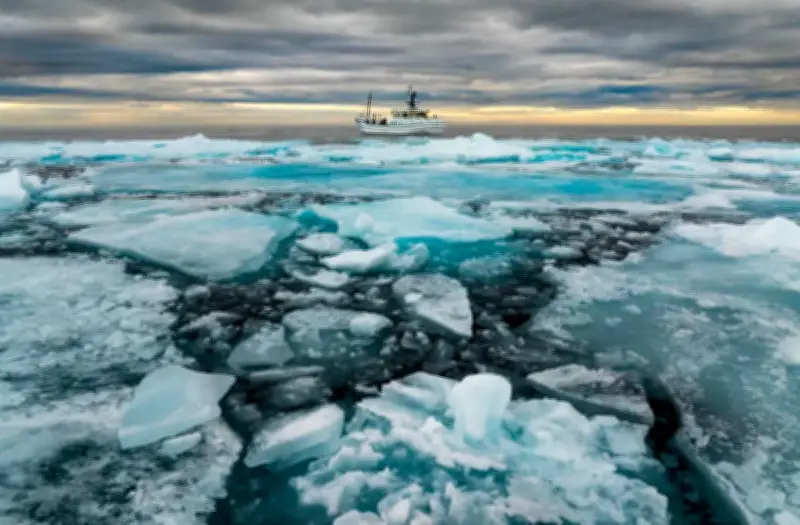
The Trump administration has withdrawn federal support for the Arctic Report Card, an annual peer-reviewed assessment of environmental changes in the Arctic, a region warming four times faster than the global average. The National Oceanic and Atmospheric Administration (NOAA) confirmed the move on Tuesday, marking the latest rollback of government-led climate science activity.
NOAA confirms withdrawal from Arctic Report Card
Kim Doster, NOAA's communications director, told the New York Times that the agency would no longer facilitate coordination of the 2026 Arctic Report Card. Doster did not provide a reason for the decision but stated: “Coordination of the 2026 Arctic Report Card will not be facilitated through NOAA … All data historically contributed by NOAA to the product will continue to be collected and will remain publicly available.”
Doster added that other NOAA programs would continue supporting Arctic research related to “national security, weather prediction, safety of navigation and the economic vitality of coastal communities.” The Guardian has approached NOAA for further comment.
Report's history and findings
Since 2006, the Arctic Report Card has tracked changes in the region's atmosphere, oceans, cryosphere, and tundra. The 2025 edition documented record-warm surface temperatures from October 2024 to September 2025, the highest since 1900, and the lowest annual maximum winter sea ice extent in March 2025, based on a 47-year satellite record.
The report also highlighted ongoing glacier loss contributing to rising sea levels, threatening water supplies, and increasing flood, landslide, and tsunami risks. In over 200 Arctic Alaska watersheds, thawing permafrost has released iron and other elements, turning rivers orange over the past decade. These “rusting rivers” have increased acidity and toxic metal levels, degrading water quality and affecting aquatic habitats, rural drinking water, and subsistence fishing.
Reactions from editors and scientists
Rick Thoman, lead editor for the 2025 report, told the Guardian: “We are scrambling to pull the pieces together. I am optimistic that we can find a path forward for 2027 and beyond. Given the late date, whether we can pull it together for 2026 is an open question, but we’re trying to make it happen.”
Twila Moon, a report editor and scientist at the National Snow and Ice Data Center in Colorado, emphasized the Arctic's relevance to the US: “The US is an Arctic nation. It’s not just a distant place. It’s also our national place. So many of the changes there have impacts that reach down into our mid-latitudes, even further south.” Moon added that losing federal support represents “a real stepping back of US leadership in the science arena, in the environmental intelligence arena.”
Broader rollback of climate science
This withdrawal is part of a series of Trump administration actions since January 2025 to curtail climate-related research. These include stripping support for studies mentioning “climate,” dismantling a climate research center in Colorado, attempting to cancel a $368m deep-sea observation system, and removing climate reports from government websites. NOAA has also stopped tracking costs of climate-fueled disasters and dismissed contributors to the national climate preparedness report.
The Arctic Report Card's future for 2026 remains uncertain, but editors are working to continue the publication independently. The loss of federal coordination underscores a broader retreat from US government involvement in climate science, with potential impacts on global environmental monitoring and policy.



