
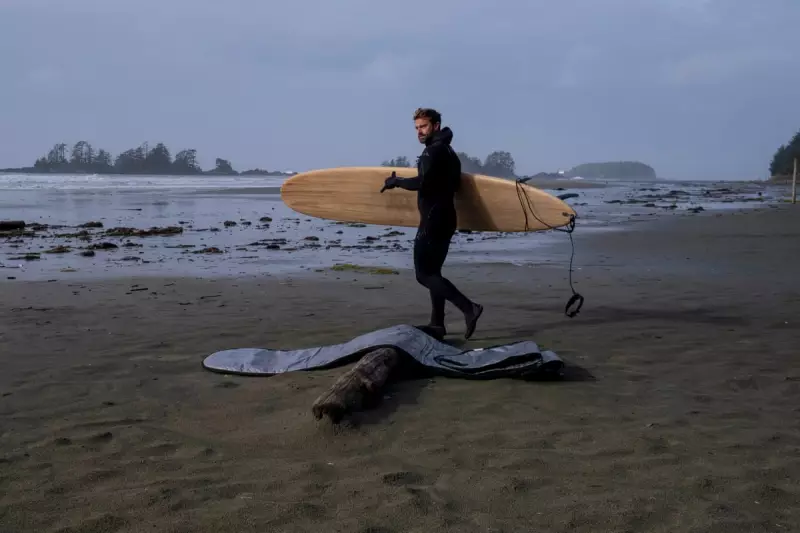
The Day the Sirens Screamed
Justin Goss was taking a shower when the piercing wail of a tsunami early-warning siren shattered the peace. Still dripping wet, he threw on clothes, grabbed his dog and rushed to his truck. The pair managed to travel just three metres before encountering complete gridlock.
"The whole parking lot across the street was jammed up. It was complete gridlock within three minutes," he recalls. "I thought, 'Oh shit, this is not good.'"
In downtown Tofino, a picturesque town on Vancouver Island's western edge, there are no warning sirens. Yet word spread rapidly through the community that people were fleeing beaches. Panicked parents rushed to collect children from day camps while restaurants in this Canadian holiday haven emptied within minutes.
Brenna MacPherson, who was working at a local establishment, remembers telling everyone to evacuate immediately. "We didn't know how bad it was going to be," she says. Some patrons settled their bills while others left without paying. Some even wandered the streets with cocktails still in hand.
The Looming Megathrust Threat
Residents of this small coastal community have long lived with the knowledge that a catastrophic tsunami isn't a matter of if, but when. Approximately 60 miles offshore, the Juan de Fuca plate slides beneath the North American plate in a slow-motion collision where pressure builds over centuries. When it finally slips, it unleashes what scientists call a "megathrust" earthquake.
Similar ruptures have occurred at least 19 times over the past 10,000 years, with the last major event recorded in 1700. That disaster saw 600 miles of seafloor drop 20 metres, sending massive waves radiating in all directions.
When the next megathrust earthquake strikes, the resulting energy will convert to a wave moving at the speed of an airliner. As it reaches shallow water, it will advance toward shore at about 20 miles per hour – slower than an elite sprinter – but swap speed for size. A wall of water reaching 20 metres high is possible when it finally makes landfall.
Preparing for the Unknowable
The July 29th Kamchatka earthquake in Russia that triggered Tofino's sirens ultimately amounted to little more than a gentle swell against the coast when the wave arrived hours later. Still, the false alarm forced residents to confront their town's precarious geography and answer a difficult question: how do you prepare for a disaster whose timing remains completely unknown?
Katsu Goda, a professor at Western University in Ontario who specialises in catastrophe modelling, recently visited Tofino to collaborate with international colleagues from Indonesia and Cuba. Their mission: develop comprehensive response plans with local officials.
During an October 3rd meeting that packed nearly 40 people into a hotel conference room, Goda delivered a sobering reality check. He explained that an earthquake reaching 9 on the Richter scale is nearly 1,000 times greater than one measuring 7. When such a devastating quake strikes, officials and first responders must ignore its immediate effects because of the tsunami that arrives mere minutes later.
Compounding the challenge are Tofino's seasonal crowds. The town's bohemian mystique and powerful waves attract hundreds of thousands of visitors who flock to its lowest-lying areas. Under most earthquake scenarios, anyone near a beach has about 15 minutes to escape to higher ground.
"You might lose five minutes waiting for aftershocks," Goda cautions. "If it's daytime, the journey is far easier than at night. And then you might be ready to leave, but then realise you need to find your kids."
Multiple Vulnerabilities in a Changing Climate
Tofino faces additional threats beyond the earthquake and tsunami risk. The town gets all its drinking water from nearby Meares Island. Meanwhile, climate change is eroding beaches and worsening storms that push water much farther inland.
The community is connected to the rest of Vancouver Island – and essential supplies like food, medicine and fuel – by a single highway vulnerable to "atmospheric rivers," rockslides and wildfires. Last summer, fires reached perilously close to this vital transportation link.
Hilary O'Reilly, Tofino's emergency programme coordinator, faces the unique challenge of educating a community that swells and shrinks with tourism. She must ensure weekend visitors understand escape routes while finding a delicate balance between fear and education for residents.
"My job is to give people control over that fear as best I can," O'Reilly explains.
Most residents have signed up for mobile phone notification services. Signs along the highway guide travellers to higher ground, and main beaches now have sirens with plans for more in town and nearby First Nations communities.
Perhaps most ambitiously, Tofino wants to build a vertical evacuation tower – a wave-proof structure that could accommodate thousands of people. Similar towers saved countless lives in Japan, and Canada's first tower is currently under construction in Haida Gwaii, an archipelago north of Vancouver Island.
However, the best sites for such towers are often the most unstable, prone to liquefaction – a phenomenon where sandy areas mimic liquid during an earthquake.
Community Resilience as the Ultimate Defence
Before Tofino became an eco-tourism hub for affluent visitors, it was an outpost for fishing and logging industries – earning the nickname "Tuff City." This legacy has fostered a hardiness and resilience that officials hope will prove crucial when disaster strikes.
Residents already endure regular power cuts and patchy mobile service. The town's disaster plans implicitly recognise that success requires faith in human nature.
"What will get us through a large disaster is a sense of community," says O'Reilly. "People coming together when they're needed is a lovely piece of humanity that emerges from unfortunate moments in the world. And we know this town will come together. Because it has to."
O'Reilly organises "high-ground hikes" for families to learn the town's topography. Meanwhile, shops sell souvenir shirts featuring a modified design: a surfer running toward a massive wave.
Despite the ever-present threat, the disaster occupies an abstract space in the town's consciousness. As Justin Goss observes: "We know that it exists, but people don't talk about it. We're not living our days in fear of a tsunami. But maybe we should think about it more than we used to."



