
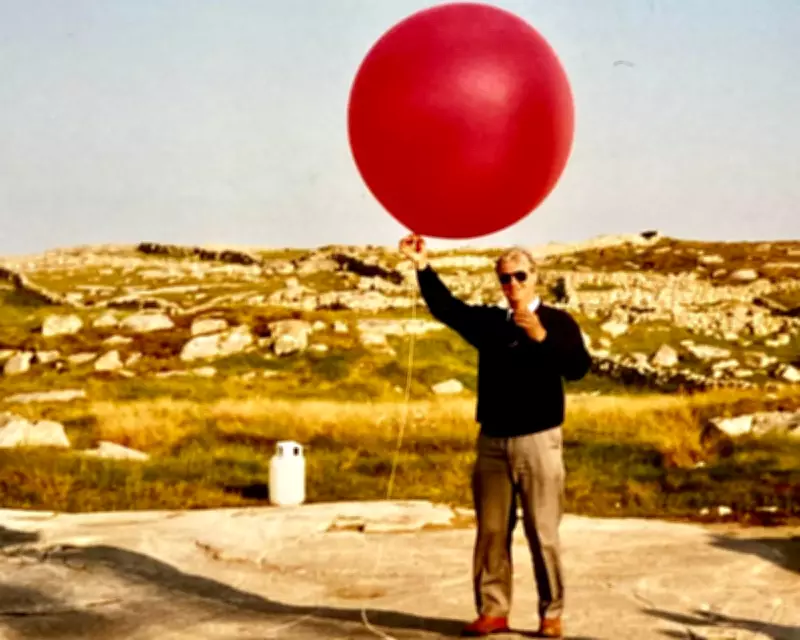
Stuart Penkett: Pioneering Atmospheric Chemist Leaves Lasting Legacy
Stuart Penkett, an esteemed atmospheric chemist whose laboratory investigations fundamentally transformed our comprehension of environmental pollution, has passed away at the age of 87. His seminal work in the late 1970s and 1980s played a pivotal role in identifying the mechanisms behind acid rain and the depletion of the ozone layer, leading to significant international policy changes aimed at protecting the Earth's atmosphere.
Groundbreaking Discoveries in Atmospheric Science
In 1979, while serving as a senior scientific officer at the Atomic Energy Research Establishment in Harwell, Berkshire, Penkett co-authored a landmark paper published in the journal Atmospheric Environment. This research elucidated how sulphur dioxide, predominantly emitted from industrial sources, undergoes conversion into sulphuric acid within clouds, subsequently precipitating as acid rain. Throughout the 20th century, acid rain had inflicted severe environmental damage, devastating aquatic ecosystems, forests, and infrastructure across Europe and North America, where pollutants accumulated over industrialized regions.
Later, during his tenure at the University of East Anglia in Norwich in the 1980s, Penkett shifted his focus to the processes governing ozone production and destruction in the Earth's atmosphere. His meticulous measurements were instrumental in identifying the detrimental role of chlorofluorocarbons and other ozone-depleting substances. This research significantly contributed to the successful implementation of the 1987 Montreal Protocol, an international treaty designed to phase out the production and emission of these harmful compounds. The protocol achieved universal ratification by all United Nations member states, with former UN secretary general Kofi Annan lauding it as "perhaps the single most successful international agreement to date." Penkett's efforts helped reverse what he described in New Scientist magazine as the "creeping horror of ozone hole-induced damage."
Academic and Professional Journey
Born in Eccles, Lancashire, in 1939, Stuart Penkett was the only child of Arthur, a fitter at an engine building company, and Ilene, a former secretary. After passing the 11-plus exam and attending Eccles grammar school, he graduated with a degree in chemistry from Leeds University in 1960. He remained at Leeds to earn his PhD, specializing in chemical kinetics, which examines the rates of chemical reactions. Following two years of postdoctoral research at the University of Southern California in the US, he returned to the UK to work in laboratories at the multinational consumer-goods company Unilever.
In 1968, Penkett was appointed as a senior scientific officer at the Atomic Energy Research Establishment, where his initial research focused on how atmospheric pollutants oxidize and damage materials. Beyond his acid rain discovery, his work at AERE and later at UEA demonstrated how the atmosphere naturally breaks down pollutants, effectively cleansing the air we breathe, and highlighted the health risks associated with poorly adjusted domestic gas stoves.
He left AERE in 1985 to join the University of East Anglia, initially as a Natural Environment Research Council reader, before being appointed professor of environmental sciences in 1990. Penkett remained at UEA until his retirement in 2004, after which he became an emeritus professor. During his career, he established the Weybourne Atmospheric Observatory on the Norfolk coast, now part of the World Meteorological Organisation's Global Atmosphere Watch network, and led the development of the UK Met Office's C-130 aircraft into the Facility for Airborne Atmospheric Measurements, an advanced airborne laboratory.
Influence and Recognition
Penkett's contributions extended beyond academia; he was a member of the Intergovernmental Panel on Climate Change, an affiliate scientist at the National Center for Atmospheric Research in Colorado, and a member of the Max Planck Society. He also advised the British and US governments on climate and atmospheric science, and served organizations such as the World Meteorological Organization and the European Research Council. In 1987, he was awarded the Gaskell Memorial Medal by the Royal Meteorological Society, and in 2003, he received the Haagen-Smit award, often regarded as the "Nobel prize" in air quality research, for his seminal paper on acid rain formation.
His leadership at UEA's school of environmental sciences established it as the UK's premier research group for atmospheric chemistry measurements. Penkett mentored a generation of young scientists, many of whom now hold significant research positions, and was known for his generosity, particularly with international visitors, whom he often treated to a traditional fish-and-chip supper after tours of the Weybourne observatory.
In 1962, Penkett married Marigold Gibbens, whom he met during his PhD studies; she worked as his personal assistant for many years. He is survived by Marigold, three of their four children—Fiona, Clive, and Rebecca—and five grandchildren. Another son, Christopher, died in 2021. Stuart Arthur Penkett's legacy as a pioneering atmospheric chemist continues to inspire ongoing research and environmental protection efforts worldwide.



